• US hits Iranian targets after tankers come under fire
• IRGC hits US bases in Kuwait, Bahrain in retaliation
• Negotiators expected to meet in Doha this week to discuss Hormuz control
• Araghchi asserts sovereignty over vital waterway; seeks collective security framework for Gulf states
• IRGC vows to make America ‘feel the pain’ after Trump threat Iran will ‘no longer exist’
WASHINGTON: The ongoing negotiations between the United States and Iran aimed at ending their confrontation seem to hang in the balance, after developments over the weekend seemed to throw a spanner in the works.
Iran did not take part in technical talks slated for Sunday due to recent attacks on the country and unfulfilled conditions of the MoU with the United States, a member of the Supreme Leader’s Office told Iranian state TV on Sunday.
Meanwhile, the Wall Street Journal, CNBC and NBC News reported on Sunday that negotiations scheduled to continue in Switzerland had been postponed amid the renewed hostilities.
US outlet Axios, however, quoted a senior US official as saying that both sides had agreed to stop strikes against each other.
The two sides are now expected to meet in Doha tomorrow (Tuesday) to work out their dispute over the Strait of Hormuz, the outlet reported.
The Tuesday talks were originally set to happen in Switzerland to address Iran’s nuclear programme, but the escalation over the weekend necessitated they be moved to a different venue and refocused them on the Strait of Hormuz.
Nick Stewart, who heads the US technical team, is expected to participate in the talks, Axios reported.
Diplomats ‘still in Switzerland’
In Washington, Dawn learnt from diplomatic circles that the negotiations were currently “on hold”, but representatives from both countries remained in Switzerland in anticipation of a political decision to resume discussions.
“No one expected these talks to be easy or to conclude quickly,” one source said.
“Pakistan and other mediators succeeded in convincing both Iran and the United States to begin talking to each other. But negotiations on the substantive issues were never going to be easy. There are many hurdles and many detractors. The encouraging aspect is that both sides recognise that war is not a solution, which is why they need to remain engaged,” a diplomatic source told Dawn.
Threats and attacks
The diplomatic setback came after tit-for-tat attacks, and a stark warning by President Donald Trump, who said the US would be forced to “militarily complete the job” if strikes in the Hormuz continued.
In a post on Truth Social, he accused Iran of violating the “ceasefire agreement again”. “There may come a point when we are no longer able to be reasonable, and will be forced to militarily complete the job that we very successfully started. If that happens, the Islamic Republic of Iran will no longer exist!”
According to US Central Command, American fighter aircraft struck 10 Iranian military targets near the Strait of Hormuz after a drone attack damaged the Panamanian-flagged oil tanker M/T Kiku, which was carrying more than two million barrels of crude oil through the strategic waterway.
In response, Iran’s Revolutionary Guards said it had launched missile and drone operations targeting US military sites in Kuwait and Bahrain, in response to recent strikes against Iran.
A US official, confirming the attacks on its facilities, told Reuters there were no American casualties, or major damage reported, but the situation was still unfolding. Hours later, alarms sounded for a second time in Bahrain, with the authorities saying an Iranian attack damaged a residential building in Muharraq province.
The IRGC, meanwhile, said that American bases in the region “will experience hell in the coming days”, warning the US that violating the ceasefire “will result in the complete halt of all diplomatic processes”.
During negotiations in Switzerland, the US delegation agreed to establish a “hotline” between the US military and the IRGC to coordinate traffic in the strait. As of Saturday, Axios reported, the “hotline” still wasn’t operational, even as Iran claimed that ships need to coordinate passage.
Increase in tensions
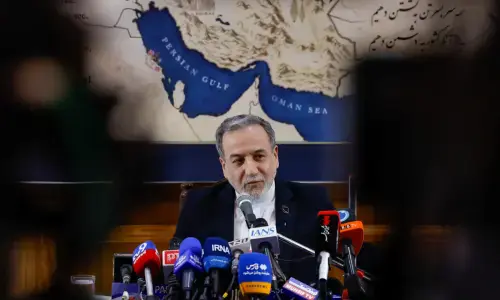
During a visit to Iraq, Iran’s Foreign Minister Abbas Araghchi warned that any challenge to the country’s control of the strait would increase tensions.
“Any attempt to adopt new or separate arrangements compared to what is underway by the Islamic Republic of Iran will only lead to more complicated situations and delays in the reopening of the Strait of Hormuz, and will increase the tensions, as we witnessed in the past two nights,” Abbas Araghchi told a news conference in Baghdad.
“The Strait of Hormuz remains under the total oversight and management of Iran through the 30 coming days, and after all obstacles are removed, the total capacity of the waterway will be restored. This is what we are working on,” he added.
“This responsibility rests on the Islamic Republic of Iran. There is no other party or state in this respect. This is totally clear under the memorandum of understanding and any intervention or any unilateral action will result in exacerbating the situation and also delay the reopening of the strait.”
The Iranian minister also called for the establishment of a security framework with Gulf countries, after Iranian strikes against US bases in the Gulf in retaliation for American attacks, AFP reported.
“We should reach a new framework that includes all countries in the region and without the presence or interference of any country from outside the region,” Araghchi said.
It may be noted that Washington has been promoting a southern lane along the coast of Oman, while Tehran, which ultimately aims to charge fees for use of the strait, wants ships to use a northern route through its waters and under its control.
With input from Agencies
Published in Dawn, June 29th, 2026