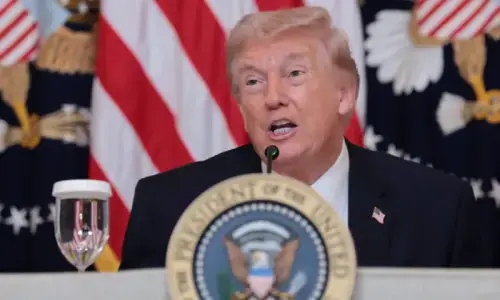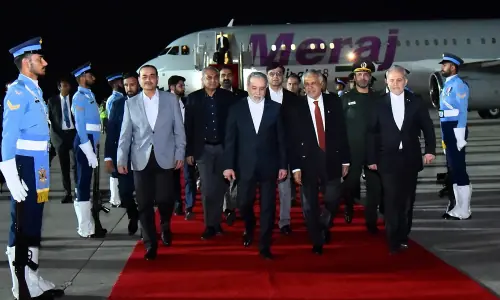
HOPES that the visit of Iranian Foreign Minister Abbas Araghchi to Pakistan would lead to the resumption of direct talks between the US and Iran did not materialise. The White House had announced it was sending US envoys Steve Witkoff and Jared Kushner for peace talks to Islamabad, but Iranian officials said no meeting with American negotiators was planned. This led President Donald Trump to cancel their trip but without shutting the door on the diplomatic process. “If they want to talk,” he said in a social media post, “all they have to do is call.”
Pakistani leaders worked hard to break the impasse between Washington and Tehran, which had taken hold over the past fortnight amid tough posturing by them. That a second round of talks did not take place was a disappointment but that doesn’t mean the diplomatic window has closed. Both sides seem to want an off-ramp from the conflict. But they are locked in a classic who-blinks-first situation, with neither side showing flexibility lest the other construes that as a ‘win’ that strengthens its negotiating hand.
The first round of face-to-face talks between the US and Iran in Islamabad on April 11 reflected their mutual interest in pursuing the diplomatic option. The talks were inconclusive but they began a potentially promising process. Negotiations, however, stalled with the second round put on hold. Several factors were responsible for this. The most proximate cause was the US blockade of the Strait of Hormuz amid a massive American military build-up in the region.
Coming on the back of contradictory messages and ultimatums from Trump, this raised questions in Tehran about Washington’s seriousness about negotiations. At one point, Trump said he was offering “a very fair and reasonable deal” to Iran; if it didn’t accept it, the US would knock out every single power plant, and every single bridge in Iran. False claims by Trump such as Iran agreeing to hand over its highly enriched uranium to the US aggravated the situation.
The diplomatic window remains open even as both sides seem to harden their positions.
The US military’s seizure of an Iranian-flagged cargo ship marked a serious escalation in an already volatile situation. Tehran denounced this as a violation of the ceasefire and act of armed piracy and pledged to retaliate. Iran’s state news agency ruled out Iran’s participation in the Islamabad talks because of “Washington’s excessive demands, unrealistic expectations, constant shifts in stance, repeated contradictions, and the ongoing naval blockade”. Tehran announced an end to the temporary opening of the strategic waterway as a reprisal. It also said it would keep the strait closed until the US ended the blockade. Trump refused, saying the blockade would continue until Iran agreed to a deal.
These tit-for-tat actions, with both accusing each other of violating the ceasefire, cast a shadow of uncertainty over the diplomatic process. As the expiry of the 14-day ceasefire approached, Pakistan’s diplomatic efforts went into high gear. Hours before the truce was to expire Pakistani leaders succeeded in persuading Trump to announce an indefinite extension. But efforts to get him to end the blockade proved unsuccessful. It was hoped the ceasefire extension would open the window to diplomatic re-engagement and persuade Iran to participate in the talks. But Iran declined saying it would not accept negotiations under US pressure and threats. As the speaker of Iran’s parliament put it, “Trump, by imposing a blockade, seeks to turn the negotiating table into a table of surrender.” He dismissed the ceasefire extension as a ploy to buy time.
Pakistani officials continued their efforts to encourage the two sides to return to the negotiating table. This involved nonstop communication between Pakistani officials and their American counterparts including phone calls between Field Marshal Asim Munir and President Trump. It also entailed the army chief’s three-day visit to Tehran for discussions and to communicate messages from Washington. These efforts, however, did not yield another round of direct negotiations.
Looking ahead, what might encourage the two sides to revive direct talks and what are the obstacles? Among incentives to renew diplomacy is that the alternative is to engage in a no-win war and an open-ended, no-holds-barred conflict that would have unacceptable costs for both. To be sure Iran will face more damaging consequences but the US would not be insulated from the far-reaching economic fallout. A prolonged, renewed military confrontation could result in widescale destruction of the region’s energy infrastructure, which would inflict pain on the American economy, where inflation is already rising. It would involve political costs for Trump with mid-term Congressional elections looming and the war being so unpopular in the US. This when Trump’s public approval ratings have also plunged to an all-time low.
Among hurdles to the resumption of talks are the maximalist positions of the two sides, which risk making them prisoners of these positions and deepen mutual mistrust. Both have been flexing their military muscles over the Strait of Hormuz believing this pressure will strengthen their bargaining position and force the other into making concessions. Iran is emboldened by its effective resistance to the combined military might of the US and Israel and its strategic advantage from control of the Strait of Hormuz. Trump’s shifting messages are another hurdle that vitiate the atmosphere and deepen Iranian mistrust. Israel, of course, remains a major obstacle, unreconciled to a US-Iran deal.
What could produce a diplomatic breakthrough? Without minimising the necessity of addressing other issues including Iran’s insistence on security assurances and sanctions relief, an understanding on the nuclear issue is what can unlock the situation. On this, common ground has to be found. Iran’s commitment not to pursue a nuclear weapons programme and stance on related issues could give Washington a deal Trump can sell as an ‘improvement’ on the 2015 Joint Comprehensive Plan of Action. But the US will need to recognise Iran’s right to the peaceful use of nuclear energy and moderate its position on removal of Iran’s stockpile of enriched uranium, which Tehran has offered to down-blend and subject to IAEA supervision. Above all, Washington has to realise it cannot expect to secure on the negotiating table what it hasn’t on the battlefield.
The writer is a former ambassador to the US, UK and UN.
Published in Dawn, April 27th, 2026