SECURITY: ON THE JAFFAR EXPRESS
Train journeys are supposed to be adventures, filled with chance encounters, often with strangers, peppered with joyous interludes at stations big and small. But when your departure, or destination, is the Quetta Railway Station, that is not the case.
As I stepped on to the platform in Quetta on a freezing morning last month, my mind raced back to the November 2024 suicide attack at this same station, which had claimed over two dozen lives.
Balochistan, Pakistan’s largest but most sparsely populated province, has faced a succession of armed insurgencies and terrorism in the past 50 years. The latest escalation has seen militants increasingly target critical infrastructure, including trains and railway tracks. This has fuelled a sense of uncertainty and the constant threat of violence.
At the train station, the anxiety was palpable. It wasn’t just the passengers who were gripped by fear; police and special units also seemed to be in a state of tense alertness, sizing up each traveller as he or she walked through metal detectors, while security cameras recorded each movement. Even the travellers’ clatter was subdued, punctuated by the barks of sniffer dogs and the whistles and horns of incoming trains.
After a brazen and deadly hijacking last year, the train from Quetta to Sindh, Punjab and Khyber-Pakhtunkhwa now moves under intense security. A first-hand account depicts how violence has reshaped rail travel across Balochistan — and why passengers still keep coming back
I was taking the Jaffar Express, which travels southward across Balochistan to Sukkur, Sindh, before snaking north through the Punjab heartland to its final destination, Peshawar in Khyber-Pakhtunkhwa — travelling approximately 1,630 kms over 34 hours. My journey was going to be a fraction of that distance, just over 350 kms till Sukkur. But it is also the scariest leg of the journey, where trains and tracks are frequently targeted by Baloch armed groups.
According to the Pak Institute of Peace Studies, there were 16 attacks on trains/ tracks in Balochistan in 2025, claiming 65 innocent lives. The most brazen of these attacks took place on March 11, 2025 on this very train.
On that day, terrorists of the proscribed Baloch Liberation Army — referred to by the Pakistan state as the Fitna Al-Hindustan — hijacked the Jaffar Express, taking 440 hostages. After a tense 30-hour stand-off, Pakistani forces finally regained control of the situation. They said they had killed all 33 terrorists involved in the attack. At least 21 passengers also tragically lost their lives.
THE JOURNEY BEGINS
Despite the harrowing history, I boarded the train in time for the 9am departure time, but the rigorous security checks delayed us by an hour. As I stepped out to take a few photos of the picturesque train station, a commando approached, reminding me that the area was under tight security. He insisted I delete my photos, a stark reminder of the fragile safety we all felt.
Back on the train, a passenger in my compartment of the carriage offered snacks to the person sitting next to him, only to be met by a polite refusal. My efforts to strike up a conversation with another fellow passenger also petered out quickly.
When the train finally started its journey, passengers across the carriage ensured that the grilled windows were tightly shut — in line with instructions from one of the paramilitary Frontier Corps (FC) soldiers on our carriage — and children kept away from them. There were at least a dozen FC personnel on the train, while I also saw at least two members of Balochistan police and one of the paramilitary Balochistan Levies in my compartment.
Maybe it was because of their presence that a mother felt compelled to chide her child for running in the passageway. The vestibules — the area between two carriages that has the lavatory and also serves as the de facto smoking area — were mostly deserted, with security personnel keeping an eye on any and all movement.
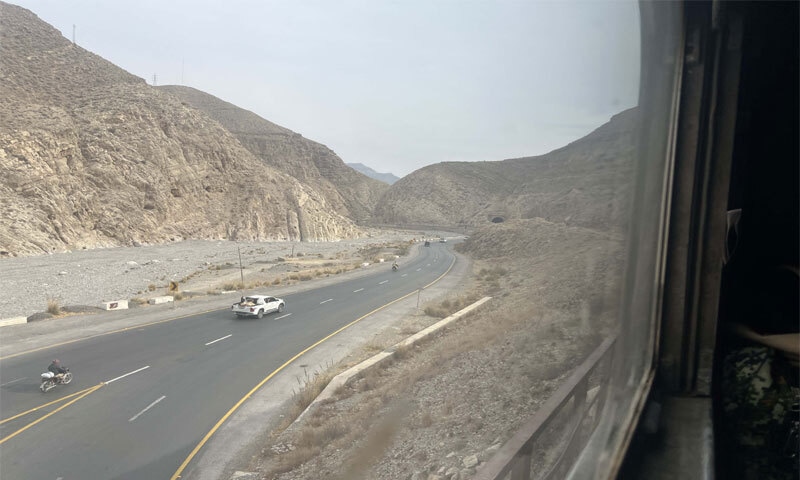
As the train careened towards Kolpur, the next stop, I saw what appeared to be security personnel on vehicles and bikes escorting us. Security check posts remained a recurring feature across the mountainous parts of the Bolan Pass, a historic mountain corridor, and all the way to Balochistan’s border near Jacobabad in Sindh — as much a source of comfort to passengers as they were of trepidation.
The silence and anxiety amplified during unplanned stops along the route; during two such stops in Kacchi district (previously called Bolan), an uneasy silence fell over the carriage.
As on any train ride, periods of silence were interspersed with scattered chatter in local languages, while vendors at stations brought moments of hilarity, with their trademark calls to attract customers.
FEAR ON THE MOVE
The train’s descent from the Bolan Pass toward the lower elevations of the Aab-i-Gum station heightens risks of accidents, particularly due to the possibility of brake failure. A 22-kilometer stretch, it requires trains to slow down, which also makes them more susceptible to militant attacks.
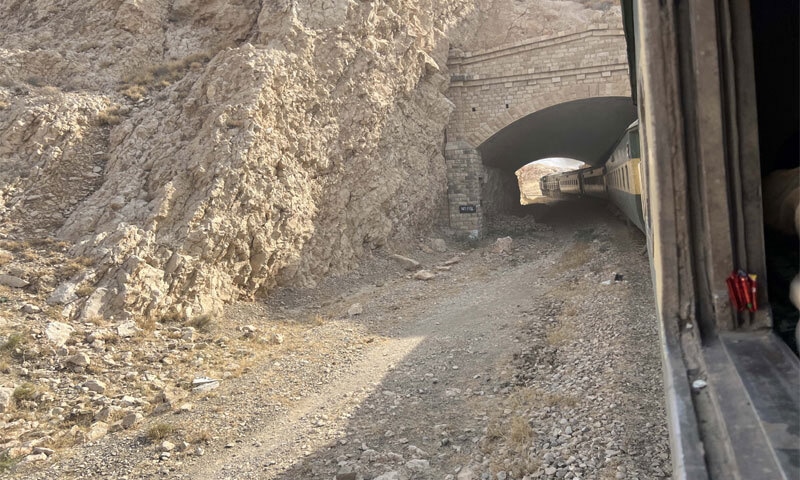
But it was the journey after Mashkaf that had everyone on the train on a knife’s edge. It includes a series of tunnels, including ‘Tunnel Number Eight’, the site of the March hijacking.
A mix of mountainous and plain terrain, the area remains far beyond modern communication networks. Cellular signals are unreliable or entirely absent and road connectivity is extremely limited. The terrorists exploited the region’s isolation and lack of accessibility to launch the attack. Despite that, the timely response from the security forces ensured that a much greater tragedy was averted.
Despite the collective fear — or because of it — passengers pressed their noses against the grilled windows to spot any signs of the March train hijacking and the ensuing gunfight. It didn’t seem to go down too well with the security personnel, but they didn’t articulate their disapproval, focusing instead on their primary task: to keep the train and its passengers secure.
Fortunately, there were no surprises this day and the train made it to the next station, Sibi, during daylight. The provincial government and security authorities have placed bans — officially and unofficially — on public transport and train movement to and from Balochistan during nighttime.
RACING AHEAD
At Sibi, a large number of passengers disembarked and new ones boarded. There was also a change in the atmosphere, no longer oppressed by fear. I got off to stretch my feet and, realising it was lunch hour, bought some food.
After a short interlude, we were back on track as the train hurtled towards its eventual destination, crossing into Sindh before the onset of darkness. But the tensions had clearly eased: passengers started strolling around, soaking in the lushness of the plains of Naseerabad. At the Dera Murad Jamali station, a young man recorded videos of the station without any interference from policemen standing nearby.
We arrived at Balochistan’s border with the westering sun, but it was still a while from Sukkur, my eventual destination. It took 12 hours, instead of the stipulated 10, to reach Sukkur.
The journey might have been nerve-wracking and exhausting, with more than just a hint of the Wild West about it, but trains — and the Jaffar Express — remain the most popular mode of transportation to travel to and from Balochistan. In fact, despite the hijacking last March, data from the railways shows that the Jaffar Express had more passengers between March and November 2025 than in the corresponding period the previous year.
One of the reasons for this is the high frequency of highway blockades, by protesters and militants, and the attacks on public buses. Meanwhile, flight fares from Quetta are exorbitant and out of reach of most residents. This makes trains the most viable and least dangerous option.
The involvement of security forces in transport has eased some of the passengers’ concerns. There are also plans to add a specialised security bogie to the Jaffar Express, to improve monitoring and threat detection using modern technology. The installation of signal jammers on the train is another preventive measure being considered.
Regardless of when that happens, the Jaffar Express will continue its run through the Bolan Pass. Each shuddering halt, each scanned ticket, each glance at a grilled window is a testament to a journey that persists despite all odds and the grim determination of those who still need to get home.
The writer is a journalist and researcher
with an interest in politics and security.
X: @ImtiazBaluch
Additional input and editing by
Hussain Dada. X: @hydada83
Published in Dawn, EOS, January 25th, 2026