Dancing terracotta figurine from 3rd century BC hints at presence of Jainism in Taxila
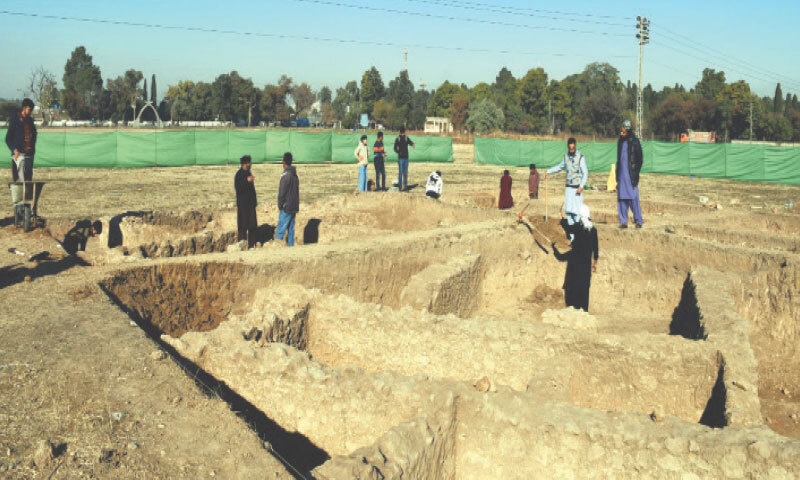
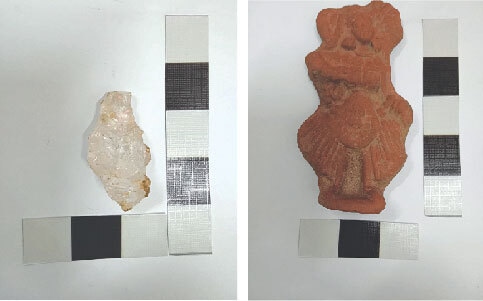
TAXILA: A newly-discovered quartz artefact and a terracotta female figurine, dated back to the early 3rd century BC, captured mid-dance, her face radiant with jubilation, are offering archaeologists rare insights into the religious plurality and cultural life of ancient Taxila, following fresh excavations at the historic Bhir Mound, regarded as the earliest urban settlement of the Taxila civilisation.
The preliminary study of these newly discovered antiquities belongs to the late Maurya period and the earliest Greek era in Taxila. Keeping in view in-depth archaeological research on such figurines testified that such artefacts are characteristically local and clearly indicate the direction from which the arts and crafts of Taxila drew their inspiration under the rule of the Mauryas,” said Deputy Director of Punjab Archaeology Department Aasim Dogar.
While leading the five-member excavation team, Mr Dogar informed that the female figurine is made of terra cotta and it is five inches in length and three inches in width, adding that “Preliminary dating places the artefacts early 3rd century BC, though specialists caution that further laboratory testing and contextual analysis are required before definitive conclusions can be drawn”.
The discoveries made by the team comprising Anam Aziz, Anmol Zahoor, Abubakar and Hanifullah during the systematic excavation of one of South Asia’s earliest urban settlements are being described by experts as significant additions to the archaeological narrative of Taxila – a city long celebrated for its role as a centre of learning, trade and spirituality.
The member of the excavation team, Abubakar, stated that terracotta figurines, however, have drawn particular scholarly attention.
Depicting a female figure wearing earrings and bangles – in a dynamic dancing posture, adorned with jewellery and expressive facial features, the artefact conveys movement, emotion and celebration, qualities rarely preserved with such clarity in early terracotta art. “This is evidence of the fact that even in the early ages of human civilisation, females were not only aware of decorative ornaments but they also utilised them as in today’s”
Hanif Ullah, an expert in excavation who spent years with the Italian excavation mission to Pakistan, expressed that it is in moulded form, and we expect that more figurines may also be discovered from the ruins of this ancient city that once flourished along the Silk Road. “The female figurine’s jubilant expression challenges the often-ascetic imagery associated with early religious traditions, suggesting that music, movement and celebration also formed part of spiritual life in ancient Taxila,” he added.
A senior official of the Federal Department of Archaeology and former curator of the Taxila museum Dr Abdul Ghafour Lone told Dawn that similar terracotta figurines unearthed in earlier excavations at the Taxila valley civilisation have been associated by scholars with the presence of Jain communities.
Comparable artefacts have been recorded at sites across the subcontinent where Jain followers are known to have flourished, strengthening the argument that Jainism had an early footprint in the Taxila region.
“Such figurines are not isolated finds,” said the senior archaeologist familiar with Gandharan material culture. “The discovery at Bhir Mound, combined with parallels from established Jain centres, suggests that followers of Jain traditions coexisted here alongside Buddhists and adherents of other belief systems,” he revealed. He added that Taxila is widely known as a major Buddhist centre of learning, but discoveries testify to its role as a cosmopolitan city where multiple religious traditions intersected.
The latest finds add weight to the view that Jainism, often overshadowed in Gandharan studies, may have had a more visible presence in the region than previously assumed. Dr Lone argues that sustained excavation and conservation efforts could yield further evidence illuminating the social, religious and artistic life of one of South Asia’s earliest cities.
Anmol Zahoor, member of the excavation team, told Dawn that Bhir Mound represents the earliest occupational layer of Taxila, with habitation stretching back to the Achaemenid period and continuing into early Indo-Greek times.
Anam Aziz, involved in the current dig, said that the quartz stone artefact, deliberately shaped and carefully placed within a defined stratigraphic layer, likely served a symbolic or ritual function.
Deputy Director of the Punjab Department of Archaeology Aasim Dogar said Dawn that newly recovered artefacts have been transferred to secure storage for conservation and detailed study and are expected to be placed on public display at the Taxila Museum after scientific documentation is completed.
Published in Dawn, January 18th, 2026