0
0

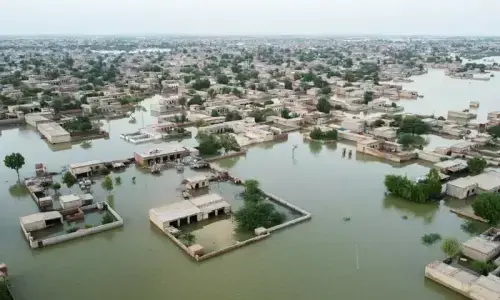
The Small Dams Organisation of Punjab Irrigation and Power Department has served 31 eviction notices on several hundred fisherfolk surrounding the Shahpur Dam in Attock district
“We're like the fishes. If you take us away from water, we'll die.”
It's early Friday, and Noor Din is overlooking Shahpur Dam which has been his home for over two decades.
“We know water. We're born to fish, to live next to water and in water,” Noor Din says, right before he turns and we start walking back towards the small settlement where Noor lives today, with hundreds of other fisherfolk like himself.
Noor Din's father shifted his family to Attock district after the Small Dams’ Organisation (SDO) completed Shahpur Dam - one of 15 water reservoirs built around the district to increase water storage and irrigate surrounding farmland.
“The fisheries department populated this place with common, silver, grass carps, rahu and singhara fish. And once the contractors moved in, it meant we had work and a place to fish,” says Noor Din.
Before the water could be populated, it needed to be cleaned. Not just for the fish but for irrigation and water supply usages.
“We cleared out the water with our own bare hands. We'd dive down and remove all the logs and junk. We made it livable, for ourselves and for the fish. And now, they're asking us to leave,” Noor Din described the crux of the crisis.
Last year, the SDO served 31 eviction notices on the occupants surrounding Shahpur Dam. According to the project director at the SDO, Shabbir Malik, surrounding areas need to be cleared so water levels can be raised to meet a request from the Civil Aviation Authority (CAA) which needs additional water at the New Benazir Bhutto International Airport near Fatehjang.
The occupants served with eviction notices include high-ranking members of the army, local landholders and several hundred Sindhi fisherfolk who moved to the area over two decades back.
“All the other occupants don't actually live in this area. But we do. We have a school and a mosque. Our children have grown up here. The rest of them can go somewhere else. We cannot. This is our only home,” says Noor Din.
Whose public interest?
“Any public interest work allows the use of government land. And thus allows us to evict anyone who is sitting on it,” says the SDO director, Malik.
It is late afternoon and Malik is visiting Attock from Islamabad to inaugurate a local canal transporting water from Shahpur Dam to surrounding farmland.
Mohammad Ali Shah, Chairman of the Pakistan Fisherfolk Forum, disagrees with Malik's analysis.
“How is increased water demand at the New Benazir Bhutto International Airport a public interest project?” Shah asks.
According to Malik, the actual requirement of water for the airport will exceed 6-7 million gallons of water a day.
“An airport is a public utility. And that means it is in the public interest,” says Malik.
“This is an example of how development projects, that are meant to serve the people, end up working against the people. It is unacceptable that the demands of an airport means several hundred people with families have to be evicted from the only home they have known for two decades without any compensation or resettlement plan in sight,” was Shah’s rebuttal.But regardless of the objections, the project has been planned and Punjab government is determined. “We're ready to bulldoze their houses to force them out,” says Rana Mohammad Iqbal, Punjab’s director of land reclamation and one of the officials present at the inaugural ceremony.
“If you're occupying government land illegally, you will be evicted,” says Malik as local member of the Provincial Assembly (MPA) Sher Ali Khan shows up to inaugurate the canal.
After some pomp and ceremony, Khan agrees to answer questions about eviction.
“Listen, if I take your car and call it my own, it doesn't mean I own it. These people have been occupying government land illegally, and they need to leave,” says Khan. He does not care that these fishermen are registered voters and their displeasure might cost him his votes.
But Shah is adamant. “The fisherfolk have a right to the land that they have been living on for over two decades. This is not a question of illegal occupancy, it is a question of an illegal eviction,” he declares.
“First, they stopped us fishing, now they are kicking us out.”
The SDO doesn't have a project document, they haven’t developed a budget for the project, they have no idea how much of the land will be inundated if they raise the dam. How can they serve eviction notices without even knowing these basic things?” asks Shah.
The SDO has not handed in a Project Concept-1 (PC-1) form, a requirement before the start of any development project.
“We have not completed the PC-1 form, so we are not aware of the costs of the project yet. However, I think the project will end up costing Rs170 million,” says Shabbir Malik.
So what is the cost of a public interest project? The answer, apparently, is Rs170 million and a couple of hundred displaced fisherfolk.
For the fisher folk of Shahpur Dam, this is another tragedy in their lives. “About three years ago the fisheries department gave the contract for fishing to a non-local company which has been bringing in other fishermen to do their work.
The previous contractor used to hire us and paid Rs1,000 for every maund (about 40 kg) of fish we would catch. But since the new contractor, we only manage to earn Rs300-400 for every 40 kg fish. It's not that our previous income was a lot, especially since the contractor who was paying us got up to 15 times as much on the market. But it was more than double of what we are earning now,” says Noor.
The price of fish on the market range between Rs7,000 to Rs15,000 per 40 kg and the sheer unfairness of the situation shows the helplessness of the fisherfolk.
The director general of the Fisheries Department, Chaudhry Mohammad Ashraf, says he too has heard about ‘the presence of a non-local company’ that has been pushing out local fishermen from Shahpur Dam.
“The original contractor was a local but there seems to be a non-local company behind them,” was DG Ashraf’s vague reply.
The fisherfolk, however, have been pushed to the margins. “We do not know what is going on. What we do know is that we've cared for this water since we were children. Three years ago, they stopped us from fishing there. And now they're trying to push us out,” summarised Noor Din.