Writers, intellectuals call for durable peace as Urdu Conference ends in Karachi

• Resolution condemns killing of Palestinians, Indian occupation of Kashmir
• Forum calls for a centre to translate Urdu works into national and foreign languages
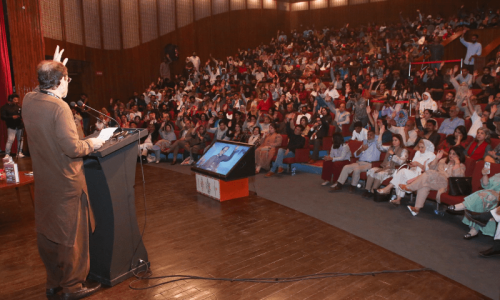
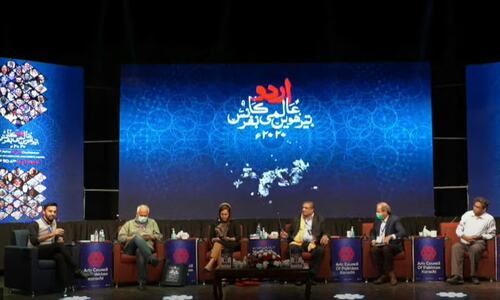
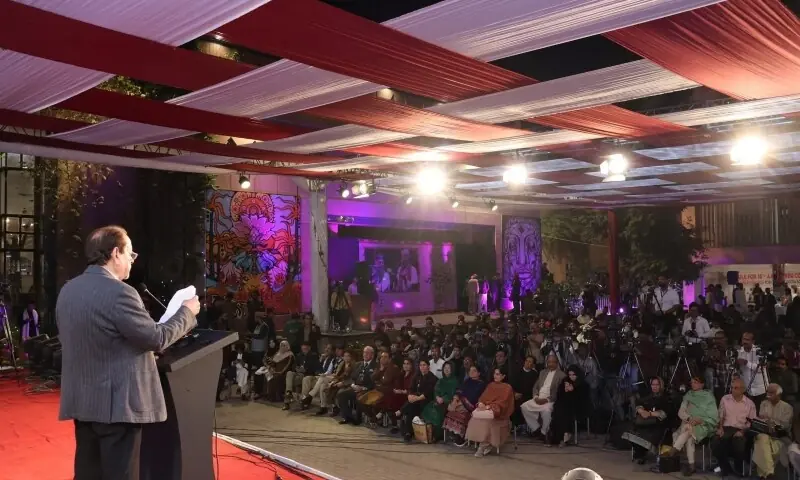
KARACHI: Writers, poets and intellectuals participating in the 18th International Urdu Conference on Sunday raised their voices for a durable peace in the world, saying that wars, terrorism and the arms race are hurdles in its way.
The four-day annual conference organised by the Arts Council of Pakistan concluded on Sunday evening with a unanimous resolution stating: “Peace is a necessity for human society. We, writers and intellectuals, raise our voices for a durable peace in the world.”
Read out by Arts Council’s President Ahmed Shah, the resolution states: “We condemn the killing of unarmed innocent Palestinians and fully support their right to self-determination. We appeal to the international community to play its role in stopping oppression and aggression against Palestinians.
“We, writers and intellectuals of Pakistan, fully support Kashmiris’ right to self-determination and condemn India’s occupation of Kashmir. We demand that the international community take steps to resolve this issue. We are proud of Pakistan’s armed forces which defeated India’s expansionist designs,” it said.
In order to create harmony among writers who write in different languages, the participants demanded that communication between them be increased. “We insist that connection and communication between writers and artists of the whole world is increased and the acquisition of visa be made easy.”
The moot also demanded a centre for translation, which could translate works published in all national and international languages. “Efforts should be made to translate works of Urdu into international languages so that Urdu writers could be recognised on a global scale.”
The participants also urged the government to make efforts to make Urdu the official language of the country as per the Supreme Court decision.
Another resolution demanded that the government bring down prices of paper and printing.
The Urdu Conference also demanded that the media, especially electronic media, play a responsible role in using the correct language keeping our cultural norms in mind.
Call for improved relations with neighbours
Poet Ifikhar Arif, who presided over the event, lauded the Arts Council for organising the Urdu Conference for 18 years without fail.
He said apart from the rest of necessary things, we should endeavour to improve our relations with all our neighbouring countries. “Political differences are not resolved through wars; you need to engage in a dialogue for that.”
Sindh Chief Secretary Syed Asif Haider Shah praised Ahmed Shah for his tireless efforts in arranging cultural events. “He has turned the council into an art city.”
He agreed with the resolution passed and said the government of Sindh is already working on some of the points. “We know Ahmed Shah can generate resources on his own but he takes us [Sindh government] along so that inclusivity could be created.”
After the speeches, the lifetime achievement award was given to Prof Khurshid Rizvi.
Session on new books
Earlier, a book launch session in the afternoon grabbed the attention of book lovers. Iqbal Khursheed spoke on the books Bhaid Bhare, a new collection of stories by Akhlaq Ahmed, and Fasana Badosh, a selection of his stories. He said this year belongs to Mr Ahmed. He has captured urban life in a successful manner and he informs the readers about ‘why they’re sad’.
Irfan Javed talked about Iqbal Khursheed’s collection of Urdu stories Chhinaal. He said the author has masterfully painted Karachi and a host of interesting characters. Among others, he has penned the difficult lives of journalists.
Waheed Noor shed light on Shujaat Sahar Jamali’s collection of poems Khwab Khwab Manzar. He said the poet belongs to the illustrious tradition of Dera Murad Jamali’s writers. He is a nice addition to the world of Urdu poets. Every verse in the book speaks of individuality.
Dr Fatema Hassan’s paper was on the complete works of Rakhshanda Naveed. She said the book is a compilation of six of her collections. It came out in March this year, and her first book was published in 1995.
Zaib Azkaar Husain focused on Jang Kahani, a book penned by Khalid Moin about his days when he worked for a magazine. He said the publication contains interview of 20 showbiz personalities. Mr Moin joined Jang newspaper in 1996 where he got to meet many people and had interesting experiences. “It’s a detailed account of his journalistic journey.”
Arshad Rizvi spoke on Zaib Azkaar Husain’s novel Band-o-Bast. He said as he started to read the book, he got involved in the story. He claimed that the novel is a step ahead of Abdullah Husain’s work.
Syed Kashif Raza shared his views on a collection of Ghazi Salahuddin’s stories Jeena Wada Khilafi Hai. He said the book contains stories that the writer wrote between 1956 and 1962, after which he stopped writing [fiction]. The marked feature of the stories is the use of ‘foil character’ technique.
Published in Dawn, December 29th, 2025