ISLAMABAD: The prediction by a Dutch research organisation of a powerful tremor that may hit Pakistan soon has not only taken social media by storm, but even authorities seem to be taking it seriously.
But even as the scientific community insisted that it was not possible to predict earthquakes this way, Iranian media reports suggest that the prediction is being taken seriously across the border as well.
The Solar System Geometry Survey (SSGS) of the Netherlands, made a prediction of a powerful earthquake along the Chaman fault line, in Balochistan.
SSGS’s methodology involves monitoring fluctuations in atmospheric electric charge near sea level, which are associated with Earth’s axis rotation, to identify regions where significant earthquake activity may occur within one to nine days.
Its claims were initially made on X (formerly Twitter) but gained currency after being echoed by Frank Hoogerbeets, a researcher and seismologist at SSGS, who has previously made accurate predictions.
Mr Hoogerbeets, a Dutch researcher, forecasted a major earthquake in Pakistan within the next 48 hours, particularly along the Chaman fault line, with a magnitude of six or higher on the Richter scale. However, it should be noted that more than three days have passed since he made his prediction on Sept 29.
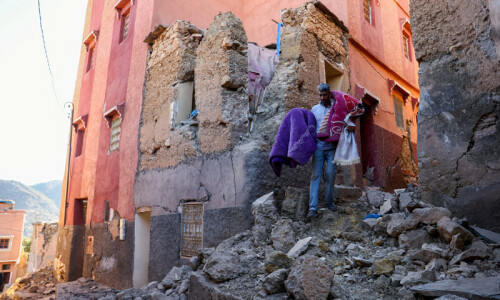
In February, Mr Hoogerbeets forewarned of a major earthquake in Turkiye and Syria and a 7.8-magnitude quake followed, claiming over 50,000 lives. On January 30, 2023, he predicted heightened geological activity across Pakistan, Afghanistan, Bangladesh, and China. Subsequently, a 6.8-magnitude earthquake struck Pakistan on February 7, resulting in nine casualties.
‘Not possible’
However, the claims of the Dutch institute have been refuted by scientists, seismologists and geologists. Even experts from the Pakistan Meteorological Department (PMD) have stated that earthquakes occur due to the movements of tectonic plates and predicting their movement deep underground was not possible “under the current scientific knowledge”.
“The formula identified by the SSGS was yet to be recognised by the scientific bodies of the world,” a senior official of the PMD said.
“This prediction is almost impossible because the earthquakes are caused by disturbances underground and it could either be due to a huge lake or crater-like structure or a rock formation like a high mountain that hits the other plates,” the official said adding, “But we do not know the terrain and formation of all the plates the world over.”
A report by BBC Urdu also underscores that currently, scientists worldwide lack the capability to forecast earthquakes, and it is anticipated that such a system will remain unavailable for some time.
According to the US Geological Survey, the prediction of an earthquake necessitates the determination of three key elements: the specific date and time, the location, and the magnitude or intensity of the event.
Separately, Professor Din Muhammad, former dean of Faculty of Environmental Sciences, University of Balochistan acknowledged reports of vibrations along the Chaman fault line due to underground activities, but clarified that the timing of earthquakes originating from this fault line remained uncertain.
Furthermore, he highlighted the presence of Global Positioning System technology in Balochistan, including Chaman, which has recorded energy build-up and plate movement along the fault line.
“So far, it has not shown any signs of an earthquake building up,” he told Dawn.
Authorities heed prediction
While the seismologist and scientists have brushed off the claims of the Dutch scientist, local authorities seem to be taking it seriously.
The Pishin deputy commissioner has called an emergency meeting of all departments concerned on Tuesday, including the PDMA Balochistan, to prepare for any eventuality, in case the SSGS prediction becomes a reality.
Published in Dawn, October 3rd, 2023