

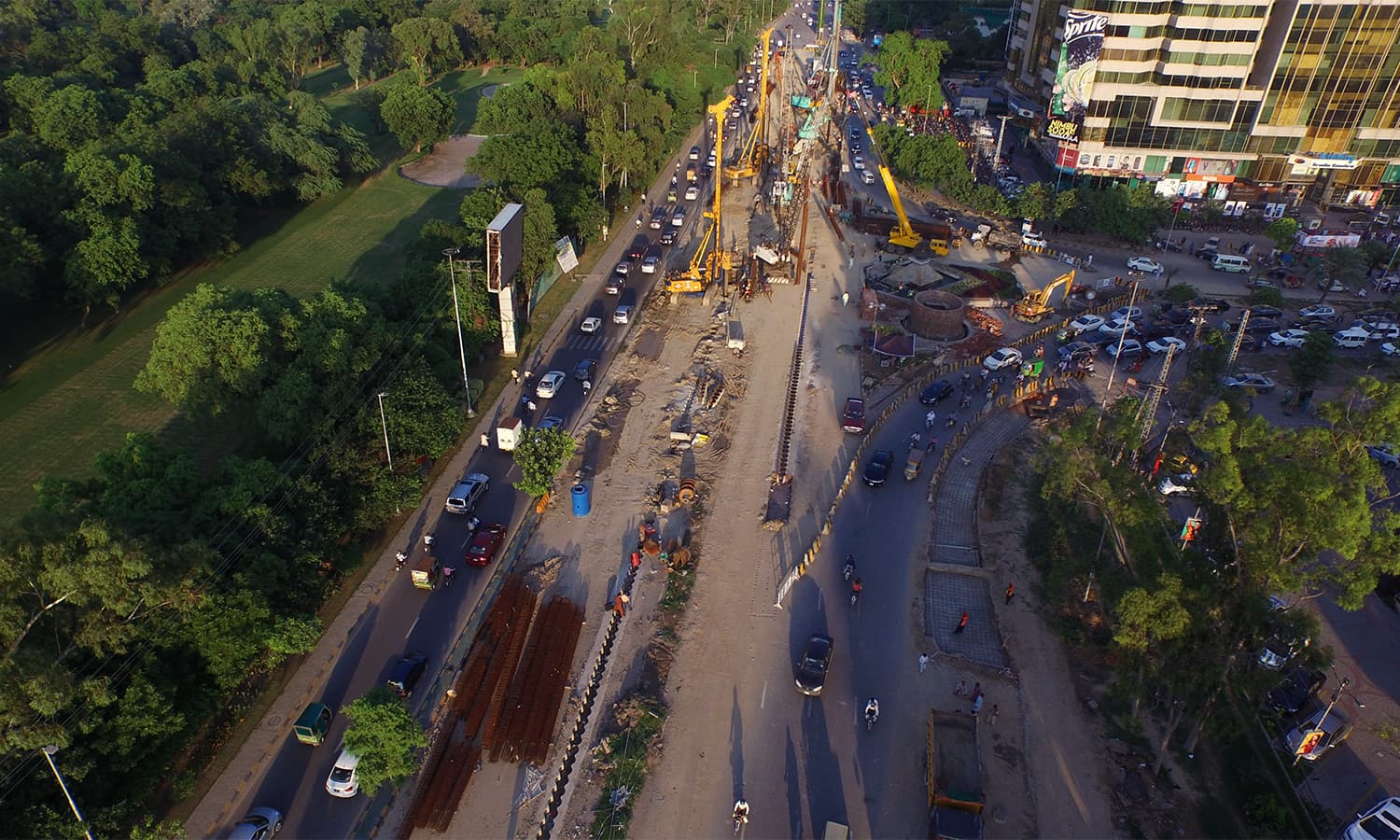
Lahore — a city of gardens, now a city of concrete
LAHORE: Environmentalist and author Z B Mirza remembers a very different Lahore. Growing up in the 1960s, when he lived in Lahore’s Model Town, he recalls wider and emptier streets; there were more trees and less high-rises. Water didn’t come in plastic gallons, but was extracted through hand pumps. It was a simple process, since the water was only 35ft under the ground. Today, it is below 200ft.
When he steps out, Mirza no longer sees the familiar streets of his childhood: instead of lush green trees lining the canal, the city’s forest cover is being cut down to make space for cars and roads. The Mughal and Sikh gardens he used to visit as a child have been destroyed.
There are hardly any ring-necked parakeets wandering about the city, and fruit trees like mulberry, guava and mango are decreasing. Instead, Lahore has transformed into concrete jungle: development projects do not factor in environmental concerns, and bridges, flyovers, brand new housing schemes are sprouting up everywhere.
“Lahore is going through a severe environmental crisis,” says Hammad Naqi Khan, the director-general of the World Wide Fund for Nature Pakistan (WWF-Pakistan). An overpopulated, urban city like Lahore cannot survive rapid and unsustainable development, which exerts enormous pressure on existing natural resources, leading to water problems, pollution, and changes in the city’s temperatures, he says.
Also read: Sink or swim— Who will save Pakistan’s drowning farmers?

Unsustainable development
While the city has seen a surge in development projects, they are usually implemented without factoring environment concerns. One such example is the Thokar Niaz Baig flyover, which was built to ease traffic congestion. According to Rafay Alam, an environmental lawyer, surveys have shown the road is not being used to its full capacity.
The Jail Road underpass is a similar case. During a public hearing, a consulting engineer of the Lahore Development Authority (LDA) confessed that the underpass was ill-planned and should be dismantled; a new underpass based on rules and regulations should be rebuilt. He suggested the project’s chief engineer be penalised for allowing construction on an incorrect course and wasting millions of rupees spent by the government.
With Lahore’s population increasing by the day, housing schemes have become a necessity. But these grand construction plans reduce the amount of land that could potentially be used for planting trees. Since there is no law which stops conversion of prime agricultural lands for housing or commercial purposes, the loophole is widely exploited by land developers. One must not ignore the fact that when unplanned housing schemes are constructed, the cost of building roads and other infrastructure is once again dumped on the government’s shoulders.
Medical practitioners have also testified that an increase in the number of concrete structures leads to an increase in temperature, causing sun strokes among pedestrians and motorcyclists during the summer.
Dr. Farzana Anees is a senior medical officer at Gulab Devi Chest Hospital. “We have noted many cases of sun stroke and dehydration in June and July, because of less shade in the city,” she says. Temperature rise is not something people associate with concrete footpaths, but like other development measures, environmental degradation directly affects human health.
There is an immediate need to develop tier two cities to reduce migration to the provincial capital, and to shift our focus from constructing housing schemes to developing green zones.
Green havens during heatwaves
Lahore has only three per cent of green area, which is continuously being paved to make room for roads and buildings. “Our government gives the lowest priority to urban green spaces,” complains Lt. Col. (R) Ejaz Nazim, a senior landscape designer and an environmental activist.The world standard requires a minimum of 25 to 30 per cent of green open space in urban areas—cities like Berlin boast upto 45 per of urban forest cover.
Unpaved green belts also fall under green areas across the city and have great environmental importance. They help in storm water drainage and act as recharge zones for groundwater replenishment. Today, when most green belts have been turned into concrete, groundwater recharge is affected and is witnessing a sharp decline. This may hold little importance for city dwellers travelling in air-conditioned cars, but for less privileged members of society like pedestrians, vendors and cyclists, it is a matter of great concern.
Some delicate trees are planted to monitor levels of air pollution in urban areas, while others help mitigate the negative impacts of air pollution. It is important, therefore, for trees to be planted with awareness of their purpose and function (or lack of).

The ignorance of the connection between climate change and urbanisation has already resulted in damage. In Karachi for example, the 1,500 deaths caused by an unanticipated heat wave could have been prevented by the presence of more parks, green belts and urban forest cover in the city.
Greenery and trees help to absorb much of the heat, and establishment of green zones can improve a city’s micro-climate, lowering its average temperatures.
The destruction of gardens
The garden of Mirza Kamran, built by the Mughal of the same name, was once a fantastic sight next to River Ravi in Lahore. Today the garden lies in ruins. If the Mughals were alive, they would be disappointed by the renovations and encroachments that have destroyed their majestic legacies.
The Shalimar Gardens located northeast of the city are also severely affected by development projects. A flyover being built right above the gardens threatens to encroach upon its space, and poses dangers to the centuries’ old gardens.
Then there are the lesser-known gardens left behind by the Mughals and the Sikhs: the Garden of Mahabat Khan, Naulakha Garden, Bagh-e-Dara, Anguri Bagh, Gulabi Bagh, Badami Bagh, Gardens of Raja Teja Singh in Chah Miran, Garden of Raja Dina Nath on Shalimar Road, Garden of Bhai Maha Singh near Shah Alam Gate; all of these have been lost because of unsustainable development. The blame lies squarely upon the government.
During the British era, gardens like the Lahore Zoological Gardens, Anarkali Garden, Manto Park (Iqbal Park) were added to the city. These sites too, are undergoing constant alteration, and are under threat.
Environmental degradation at the Canal
The Lahore Canal road, which stretches over an area of 1,000 acres, is a hotspot for traffic jams. The government’s friendly attitude towards the automobile industry (i.e. less taxation) has led to a surge in vehicles, especially in Lahore and Karachi. In the absence of an efficient public transport network, this has resulted in a population to vehicle ratio that is going out of control. To make matters worse, Lahore’s air pollution levels are already disastrously high, since automobiles lead to an increase in hazardous elements in the atmosphere.
Naseem ur Rehman, the director of the EPD, testifies that air pollution is caused by traffic congestion, which increases particulate matter in air beyond the limits prescribed by WHO. “We need to control the number of automobiles on our roads,” Rehman recommends.
In 2012, a JICA transport study conducted for the government of Punjab over three years found that there were 350,000 automobiles and 850,000 motorcycles in Lahore. It found that 40% of Lahore’s population walks to work; 20% uses motorcycles, 22% uses public transport and 8% uses cars.
The following year, the Canal was declared a protected area under Section 3 of the Lahore Canal Heritage Park Act. The Act banned all construction, clearing, removal, and damage of trees along the canal’s length, but repeated violations of the Act have resulted in extreme environmental degradation.
In a supposedly ingenious move to solve the traffic congestion problem, the government decided to widen the roads along the canal, and cut down the trees. National Engineering Services Pakistan (Pvt) Limited (NESPAK) did not recommend going ahead with this plan, since road-widening is a temporary solution; it may ease up traffic along the Canal briefly, but with the increase in vehicles and poor traffic regulations, a more sustainable plan is required.

Cutting trees, planting trees
“Lahore was once known for its lush green gardens,” says Ijaz, a concerned citizen. “But is now known for its maze of underpasses and overpasses.” Ijaz feels the surge in developmental projects, especially road widening, has taken a toll on the city’s tree cover. The reduction of tree cover around the Canal, specifically, has removed the habitat for many species, including feral cats, small Indian mongoose, Indian monitor lizards, butterflies, fireflies, grey hornbills, yellow-footed green pigeons, white breasted kingfishers and purple sunbirds.
Chopping down trees to widen roads affects both Lahore’s scenic beauty, and the city’s carbon sink, which is a natural or artificial reservoir that helps in removing carbon dioxide from the atmosphere.
But instead of planting more trees to replace the old ones, what little is left of the green belts is being converted into a display of exotic plant species that have less foliage, host no biodiversity, and have little or no shade. On top of it all, they require more attention in pruning and watering, which adds to the burden of the provincial budget. According to a 2007 report by World Bank, unsustainable development and the cutting down of trees is costing Pakistan Rs1 billion rupees every day.
“This was back in 2007,” Nazim observes. “We should think about how much environmental degradation is costing us now.” Nazim, who is also the president of Shajardost Tehreek (Friends of the Trees), does not believe in opposing development plans, but he feels they must be “balanced, sustainable and equitable.”
An exotic, futile hobby
The government’s new hobby to plant exotic species rather than indigenous ones has proved counter-productive for the ecosystem. Exotic plants have little ecological importance for Pakistan since they are alien to the country's climate; unfamiliar species create complications and some prove to be invasive in nature because of their high survival and germination rates. Meanwhile, indigenous species of plants help the ecosystem since they host biodiversity.
“In order to mitigate urban forest cover loss, the government should plant indigenous species of plants,” Z B Mirza recommends. Jaman (black plum), mango, lasura (gum berry), papal and safeeda (eucalyptus) are excellent options, because unlike exotic species, these plants are certain to thrive.
In order to justify their unsustainable development methods, the government has traditionally argued that three times as many trees will be planted to balance out the losses. What the government fails to realise however, is that small exotic plants do not have significant ecological value when compared to large native trees.
Saplings emit less oxygen, have a low survival rate and cannot provide habitat to any species of birds for roosting and nesting. Most importantly, this results in a declining of Lahore’s water table.“Paving green, soft, permeable soil prevents natural recharging of our underground aquifers,” Nazim explains.
Drinking arsenic
Lahore’s groundwater is replenished by River Ravi and rainwater, but the river is already polluted by industrial and municipal waste that contaminates the underground water table. In a report, WWF-Pakistan highlights Lahore’s poor management of Lahore’s water resources. Lahoris, it recommends, should make their water consumption patterns more sustainable, and promote rainwater harvesting—a technique used by several countries to conserve rainwater and its benefits, but one that is unknown in Pakistan.
Rainwater could help raise city’s water table, but most of it goes to waste. Normally, it seeps through vegetation and unpaved areas, recharging the aquifer. But reducing green zones to increase concrete structures means that there are more drains than vegetation, and the rainwater flows into them.
Water samples taken from Jamiya Mosque Haloki, Anwar-e-Madina reveal that water contains twice the minimum arsenic level recommended by the WHO. Government authorities are responsible for the water supplied to these mosques, which is apparently also infused with human waste. This means that safe drinking water – which is a basic human right – is not available to all of Lahore’s population. Medical experts discourage using tap water for drinking purposes since it contains harmful pollutants like lead.
In response to the water crisis, WWF-Pakistan has teamed up with Coca-Cola to install 15 water filtration plants in low-lying areas of the city which lack access to the basic right of clean water supply.
Growing horizontally, not vertically
“Pakistan needs to rethink how it develops its cities,” says Ali Tauqeer Sheikh, the CEO of Leadership for Environment and Development (LEAD) Pakistan and director of Asia, Climate and Development Knowledge Network (CDKN). He feels the problem lies with development taking place “horizontally” rather than “vertically” – which increases the country’s carbon emissions, leads to a loss of fertile land and increases commuting time and cost.
“Cities grow vertically to respond to such challenges,” Sheikh explains. “Lahore is not entering the 21st century [properly]… it is turning into an overgrown village.”

Sheikh says the growth of industries has led to the construction of sprawling industrial zones in sites which could have been growing basmati rice. “We are compromising our food security by vowing for unsustainable development,” he adds.
Lawyer Ahmed Rafay Alam has some viable solutions. In the absence of sufficient urban forest cover, Alam says the government is destroying the city’s natural environment by building on green zones. “Building new roads might not help reduce traffic, but reducing cars can be the right move,” he suggests. “Meanwhile, we have to stop horizontal expansion.”
For Alam, sustainable development is “low rise, mid-density, mixed-use” and has less harmful impact on the environment. Pakistan, for example, could pick up a few lessons in city-planning from Latin America, where countries have paid the price of unplanned urbanisation.
In the 1960s and 1970s, rural populations rapidly demanded more and more service land, and the planning and development sectors could not deliver. Informal land dealers and developers found an opportunity to expand and grow in the absence of a framework. Cities then grew unplanned, creating issues like traffic congestion, inequality and loss of productivity. It was later proved that the cost of improvement programmes in unplanned urban areas is between three to five times more than the cost of urbanising unoccupied land.
An integrated approach
Our government has become savage and reckless when it comes to protecting the environment. With every tree that falls, every new car emitting carbon into the atmosphere, and every species losing the battle to maintain diversity, our ecosystem is getting weaker. If we are harmed by heat waves, smog, declining water levels and urban flooding, then we are also responsible for it.
We must decide whether we want to protect the environment and lead a healthy lifestyle, which includes healthy food, clean drinking water and refreshing air; or if we want to continue harming it. Cities and urban spaces are centers of development challenges—they might create new opportunities, but experts say the battle against economic collapse, climate change, poverty and health will either be won or lost in cities.
Syed Muhammad Abubakar is an environmental writer with an interest in climate change, deforestation, food security and sustainable development. He tweets @SyedMAbubakar


