0
0

Travelling in the subcontinent, across its varied landscape, its mosaic of hill, plain and river, could be so much fun, such a call to adventure. But given our jealousies and animosities, and our sheer talent for petty bloody-mindedness, it is a pain in the neck.
Imagine Dhaka as your destination from anywhere in Pakistan, a path that can be as straight as the crow flies, but having to reach it from Dubai, so far out to the west. That's exactly what a group of us had to do to attend a session of SAFMA in the Bangladeshi capital.
What's SAFMA? The acronym stands for South Asia Free Media Association, the organization conjured out of nowhere by journalist Imtiaz Alam and which for several years now has been bringing journalists from the subcontinent together, even during the height of the standoff between India and Pakistan.
Good initiatives and high-minded endeavours are easy enough to start. It's keeping them alive which is the difficult part. And for this all kudos to Alam and his team of enterprising youngsters who've organized one surprising event after another: Islamabad, Kathmandu and just now Dhaka.
The main financial backing for this activity has come from the Norwegians and their aid agency, Norad. It's hard not to notice that the Norwegians are also helping with restoration work in the Lahore Fort, specifically upkeep work on the Sheesh Mahal. Which may be a credit for them but a shame on us.
What does it say about us? That we can't even look after our heritage. The Norwegian pledge to the Sheesh Mahal is a little less than a million dollars. Couldn't we spare this amount from our governmental extravagance? It is this philistinism which really gets to an observer of the Pakistani drama. Little sense of what is appropriate. Little sense of what makes us look ridiculous.
But back to Dhaka and the beauty of Bengal. The poetic term Zulf-i-Bengal--or the long hair of Bengal, there being no exact translation of 'zulf' in English--was not coined for nothing. Go to Dhaka to know why. You'll be missing heartbeats all the time.
The subcontinent is a land of breathtaking contrasts. This vast kaleidoscope of colour and variety--from the Himalayas to the ocean and from the hills of Afghanistan to the waters flowing into the Bay of Bengal--is what gives the subcontinent its distinctive magic.
And Bengali music, there's a wistful and nostalgic quality to it. You may understand nothing of the words but unless a qualified ass, you'll find the rhythm and lilt haunting.
The great K.L. Saigal sang many Bengali songs and--as I was told by my friend Ali from the Bangladesh Observer-- was commended by Tagore himself for the way he rendered the master's songs. Only six of Saigal's Tagore songs, I was told, were ever recorded. Or perhaps only six whose recordings remain. How desperately I wanted to get my hands on them but each time I arranged with Ali to go music-hunting something intervened.
We had a very full programme and rather too many lunches and dinners, a tribute to the excellent arrangements made by our Bangladeshi colleagues. This left us with little time for anything else. But never mind. Next time.
How did we in West Pakistan manage to deal ourselves out of East Pakistan? I would ask myself this question all the time. Among the many reasons for this, surely one was the irredeemable philistinism of the West Pakistan ruling class. Had there at all been a feel for Bengali music and culture, or any music or culture for that matter, the conqueror syndrome which ultimately drove the people of East Pakistan to seek a life of their own might have been a bit tempered.
There are many attractive sides to the Punjabi psyche. The Punjabi, whether Muslim, Sikh or Hindu, is full of a certain elan and a joy of living, all these things best seen in his dance, the bhangra. But the philistinism also forming part of this psyche is its least attractive aspect.
The god of war may forgive Lt Gen Niazi, our Tiger (the very nickname which went with his name) who surrendered before the Indian commander, Lt Gen Aurora. But the Muses would be less forgiving towards the lack of culture which was one of the principal reasons why we failed to hold the two wings of Pakistan together.
But talking of Punjabis, is anything more uproarious than their getting together in a mood to talk after the day's work, or indeed the lack of it, is done? Well, not only we Punjabis but others too from both sides of the divide would get together in the evenings and these sessions, well lubricated by frequent calls for ice from room service, was perhaps the best part of this seminar. (Whatever do the English mean by 'happy hour'? Strange uses to which the English language is put.)
It was great this chance to hear each other's point of view. After listening to Dileep Padgoankar, Prem Shankar Jha, Karan Ranbir Sawhny (a personality as attractive as the name), Sushant Sareen, Kuldip Nayyar, Jawed Naqvi and a few others, I, and I'm sure other Pakistanis too, came away with a much better understanding of what's it like in India these days. And what the different strands of thinking or feeling are.
Not that all the Indians agreed with each other. But that was just it, what made our discussions so fascinating. We got a composite, not a monolithic, picture of India today. And I think the same was true of the Indians who must have got a better understanding of how things are playing in Pakistan.
This was the great thing about Agra too. Not so much the fact that Indian and Pakistani leaders were talking after a period of sharp tension but that for the very first time a group of Pakistanis, courtesy the indulgence they were shown by Indian TV channels, were getting to speak directly to an Indian audience.
That the opportunity was squandered and the whole thing blew up is perhaps no one's fault. There is nothing more juvenile than to apportion blame in such cases. The important thing remains that such a thing happened and that, given some help from the gods, it can happen again.
A greater exchange of ideas, being able to read each other's newspapers, seeing each other in the flesh (quite a few in the journalistic world not being bad-lookers), and by turns dispassionate and polemical on television are achievable objectives.
More to the point, they are desirable objectives. There's never been an iron or bamboo curtain in the subcontinent, only walls plastered with mistrust and a fair dose of small-mindedness. Well, if we want to be spared 'facilitation' by second-ranking officials from the US State Department, we better think of tearing those walls down.
Is it a matter of pride for either country that every now and then Deputy Secretary of State Richard Armitage should be brokering peace between them? No reflection on Armitage whose muscular frame I admire, only on ourselves and our inability to do the right thing left to our own devices.
Sure we have our differences and, thinking of Kashmir, serious ones at that. But the answer to that is not to go behind the sandbags. It is to engage with each other. Something in which SAFMA has shown the way but which needs to be done by both countries at a higher level.
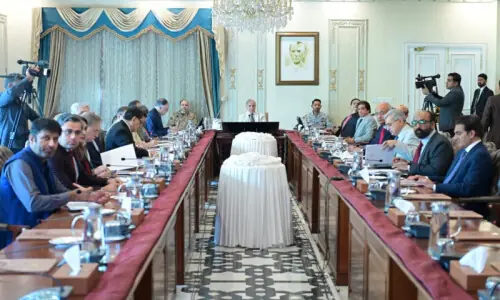
Begum Khaleda Zia, the BD prime minister, addressed one of the sessions and later stayed for lunch. Happening to sit next to her, I couldn't resist saying as soon as I had her ear that back in 1967-69 when her husband, the late President Ziaur Rehman, was a company commander in the PMA, all of us in the Academy were her secret admirers. We used to look wide-eyed at her as she drove past in her Ford Cortina.
At the compliment she kept a straight face, no stern look, the face just impassive. But at the reference to the Cortina she broke into a smile.