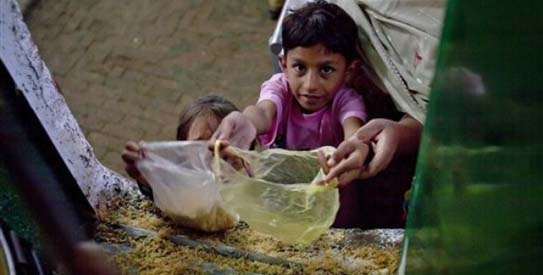
- High prices for staple foods are squeezing millions in Pakistan.—AP photo
She began begging in streets. But that didn't help. So the maid, 25, decided there was only one way to deal with crushing poverty.
She jumped in front of a speeding train with her two sons and daughter, all under the age of 3.
“Bashiran told me the night before that it would be better for everyone if they all died,” said her mother-in-law, Barkat.
Pakistanis react to widespread hardship in many ways. Some head abroad looking for jobs. Others are drawn to militant groups.
In the ten months to October of 2011, about 1,600 people decided that suicide was the only option, according to the Human Rights Commission of Pakistan.
The previous year 2,399 people killed themselves and poverty was a significant factor, but a precise breakup was not available, the commission said.
Suicide linked to poverty is not unique to Pakistan. Since the mid-1990s, an estimated 150,000 small farmers have committed suicide in neighbouring India, mostly over debts, according to the Center for Human Rights and Global Justice at New York University.
But Pakistan has nowhere near the economic power that India does, so tackling social ills could be more difficult here.
Growing economic pressures could push the suicide figure even higher in the South Asian nation where over one in five people live below the international poverty line of $1 a day.
Critics say alleviating poverty has never been a priority. In the 2011-12 budget, Pakistan's government allocated 0.04 per cent of spending for social protection schemes.
By comparison, just over 17.8 per cent went to defence, though some experts put the figure at 26 per cent.
Shahnaz Wazir Ali, special assistant to the prime minister on social affairs, argues Pakistan has made enormous efforts to eradicate poverty including monthly cash grants to poor families headed by women.
“The government has led a very targeted and focused approach,” she said.
People like Talib Hussain, 45, didn't seem to benefit. He borrowed money to start a livestock business but it folded. One creditor after another threatened to call the police if he didn't pay up.
“POVERTY TOOK MY FATHER AWAY” When the pressure became unbearable, he walked out of his thatch-roofed mud hut house early one morning, wrapped his turban around his neck and hung himself from a tree.
“Poverty took my father away. If someone had helped us maybe he would still be with us today,” said his weeping, 16-year-old son Riaz Hussain, who scratches out a living selling dried fruits and nuts from a stall.
“We didn't even know who to ask.” Those who can't bring themselves to commit suicide or infanticide, and still can't find ways to provide for their children, sometimes abandon them.
The Edhi Foundation, the largest private provider of social services in Pakistan, says last year it rescued 110 such babies.
Outside orphanages, the organisation leaves cots with signs above them which read “Do not kill your children, leave them here and we will care for them.”
Part of the problem is Pakistani leaders are often too consumed by power struggles or tussles with the Supreme Court and powerful military to address social ills.
“My central thesis on this is nobody gives a damn. The political parties don't care,” said Tahira Abdullah, a socio-economic development worker and human rights activist.
“There is an intense struggle for power now in Pakistan ...They all have noble-sounding intentions but the road to hell is paved with good intentions.”
Fresh political uncertainty has again left many Pakistanis wondering when their leaders will ever offer relief.
High prices for staple foods are squeezing millions.
Pakistan's consumer price index rose 10.10 per cent year-on-year in January, slightly more than projected. Analysts said they expect it to rise further in coming months.
Pakistan needs to take immediate measures to stabilise growing budget pressures and to raise interest rates to contain rising inflation, the International Monetary Fund warned.
The government has failed to implement politically-sensitive reforms such as cutting subsidies and widening the tax base to create a stronger economy in the long-term.
Until that happens, Pakistan may see more cases like Sher Mohammed's. He is sitting in a jail in Karachi on charges of murder.
Piling debts made it impossible for the milk vendor to take care of his six children, half of them disabled. So he gave his three daughters sleeping pills and drowned them in a water tank used by his cows, police say.
His wife, Aasia, is now struggling to sell milk and has taken on the crippling interest payments.
"He never told me exactly how much he owed. But it was probably hundreds of thousands of rupees (several thousand dollars)," she said, speaking inside a two-room cement home.
"My life has become an even bigger hell. I cry for my dead children and then I struggle to feed the ones that are alive."