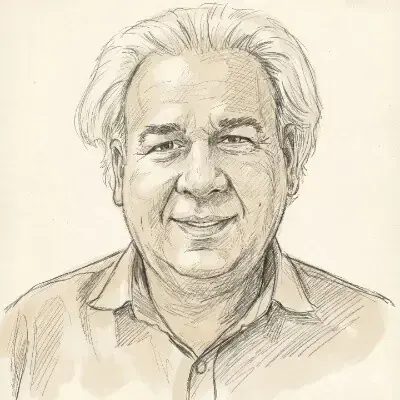
KARACHI, Feb 4: In Pakistan’s diversity lies a measure of its resilience. This was argued by distinguished journalist and author Anatol Lieven during his talk at the Oxford University Head Office on Saturday.
Mr Lieven’s talk basically gave a sketch of his book ‘Pakistan: A Hard Country.’ He began by asserting that Pakistan was not a failed state and said the people who had gathered to listen to him were proof of it. Pakistan was not Afghanistan, Chechnya or Somalia. He maintained that his book was about the sources of resilience in Pakistan, which could be sources of stagnation as well (in terms of development). To explain his point, he said he had used the expression ‘Janus-faced’ many a time in the book, and that the editors had made 18 deletions of the phrase, leaving just half a dozen. The book was an attempt at discussing power in the country, how it is exercised and what are its roots – religious, cultural etc. This central theme was set against the background of the war in Afghanistan and the rise of militancy in Pakistan. He told the gathering that when an American publisher read it he was taken aback because he had thought that it would be about the Taliban and an impending Islamic revolution in Pakistan. He added that it also discussed the role of the military and the four provinces and the difference within those provinces.
Mr Lieven said he had spent a lot of time talking about the diversity in Pakistan. For example, how Karachi was different from the rest of Sindh and how Punjab was an immensely varied region. Also, the important role that kinship played in the country’s politics and power struggles. In his view, a measure of its resilience lay in the country’s diversity, because of which, however, it was sometimes difficult to get things done. He argued that Pakistan couldn’t have an Iran-style revolution because it didn’t have a monolithic culture.
Mr Lieven said that as he was a journalist he got quotes from the Pakistani people in their own words. The problem with the West was that it didn’t listen to people directly and therefore had a flawed understanding of things. If you were to know about the tribal justice system in Balochistan, you had to talk to a Baloch sardar, he pointed out.
With respect to militancy in Pakistan Mr Lieven said that although the fear of terrorism was pervasive, and that it had claimed numerous victims, the insurgency was limited, particularly after the 2009 Swat operation in which militants were driven back. However, he added that insurgency was common in the region and, except for Bangladesh, every country had faced it.
Mr Lieven said sympathy for the Afghan Taliban in areas like Peshawar was similar to the support for the mujahideen in the ‘80s. It did not necessarily mean an Islamic revolution. He argued that up to a certain point the situation did appear perilous but the post-Musharraf scenario proved that if the state and the army made a concerted attempt things could be done. He said his book also took issue with the US foreign policy. The US should realise that Pakistan is a much more important country than Afghanistan and that it needs to tread lightly here. He said however that the Osama bin Laden operation had impacted public opinion in the US, and if there was a terrorist attack in the US or India in future, US retaliation could be severe. It was important for Pakistan to continue visible cooperation against international terrorism, he remarked.
Replying to a question, Mr Lieven said one of the reasons he used the word ‘hard’ in the title of the book was that he would often hear the phrase ‘Pakistan is a hard country’ from the locals. He gave the example of a Chaudhry in Punjab who, explaining the killing of his detractors, commented that Pakistan was a hard country.
Responding to a query about bin Laden’s killing, he said there was an intellectual awareness about Pakistan in important circles in the US. The US was engaged in a war it could not win but was determined not to be seen to lose. He informed the gathering that he once asked an American general to define victory. The general replied he couldn’t define victory but knew that defeat looked like Saigon.
On the question of Balochistan he said there was a time when only one tribe would be rebelling against the state but now a mass of semi-educated de-tribalised youth were joining the Baloch rebellion.
Anatol Lieven is professor of International Relations and Terrorism Studies at King’s College, London and a senior fellow of the New America Foundation in Washington DC.