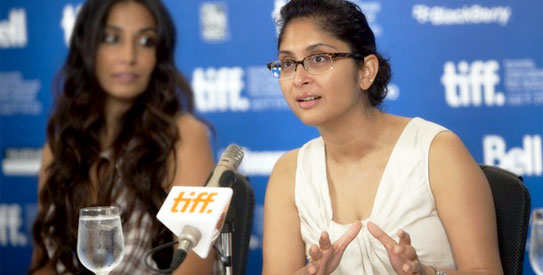
For someone who lives in Mumbai, Kiran Rao certainly seems to keep her distance from Bollywood.
The 36-year-old filmmaker admits she hasn't seen a lot of Hindi movies and that her first film as director may not appeal to mainstream Indian audiences. "Dhobi Ghat" received critical acclaim on the festival circuit and opens in Indian cinemas on Friday.
Rao spoke to Reuters about why she can never make a Bollywood film, how "Dhobi Ghat" evolved and how she got back to films after a devastating miscarriage.
Q: Growing up, did you always want to be a filmmaker?
A: "No, I didn't. I grew up in Calcutta where I lived till I was 18 and I was interested in the arts, but I didn't watch a lot of films growing up. We weren't encouraged to go to the theatre. The only movies I watched was at a club where my parents were members and which screened a movie on Friday nights. So my movie watching was very censored. By and large I haven't gone to a theatre and watched a Hindi film. My exposure to Hindi cinema was much, much later and I still haven't watched a vast amount of movies in this industry. I am much more influenced by theatre, paintings, books, music – the other arts.
Even now I have to tell myself to go watch a film in my free time. It's not my first instinct. I'm not film-obsessed."
Q: Then how did you end up becoming a filmmaker?
A: "Well, I went to Jamia (in New Delhi) for my mass communication degree and watched a lot of films in class. We watched Tarkovsky and a lot of documentary films, which was much more artistic cinema – cinema as art basically and that appealed to me greatly. It made me realise that maybe there was a place for me in the world of cinema."
Q: But you assisted on films like "Lagaan" and "Swades" which were hardly that kind of cinema.
A: "When I came to the industry, I realised I had a very theoretical approach to films and that I needed to cut my teeth on some serious, practical work. Then my friend Reema Kagti said do you want to assist on 'Lagaan' and I said yes. I was happy to be associated with great production houses and working with directors I could learn things from, so I was using these things to build my practical understanding of filmmaking. It was not so much the aesthetics of the films that I was working on them for."
Q: Have you combined the theoretical and practical approach in "Dhobi Ghat"?
A: "It's very important to be able to combine the two, you cannot get away from the practical aspect. And the theoretical aspect gave me an aesthetic base in this industry and helped me find my own sensibilities as a director. So yes, the two aspects have combined in 'Dhobi Ghat.'"
Q: When you were an aspiring filmmaker, what did you imagine your first film would be about?
A: "The interesting thing is that I didn't know what it was going to be about. My journey for the last six or seven years in this city has been to find a subject that resonates with me. When I was in film school, I thought I would make a film in two years, but I wasn't evolved enough to write something that interested me for more than a month. And your first film is always special because it defines who you are, your sensibilities. But when I finally got an idea for 'Dhobi Ghat', I knew this was something I wanted to revisit and chew over."
Q: When was that?
A: "This was somewhere in early 2005. Aamir (Khan) was shooting for 'Rang De Basanti' and was shooting in Punjab and Delhi and he would leave at 6 a.m. And I would be sitting in the hotel room and writing.
That was a great exercise for me, because in the city you always have something distracting you. So it was a great mental space for me to write the film."
Q: Isn't it ironic that you wrote a film about Mumbai so far away from the city?
A: (Laughs) Yes, that is true. I think it helped me because all the experiences were already in my being, they were part of my fibre. I didn't need to reference it."
Q: Obviously your sensibilities are very different from those prevailing in Bollywood, but you've lived in the heart of the film industry for the last ten years. Have you gotten used to it?
A: "I've realised that it's easy to generalise about anything in life.
I was looking at Bollywood through a different lens. Mainstream commercial films are not what I go out for, but working in the industry has given me a different perspective on it. I've begun to see spaces within the Hindi film narrative and have also begun to appreciate the very special language that Hindi films have. I don't know if formulaic, large brushstrokes cinema is my cup of tea, but I have begun to appreciate it."
Q: So you don't see yourself making a Bollywood film?
A: "I don't see myself making formulaic cinema, no. I do think that I could maybe broaden my brushstrokes a little bit and make a film that will appeal to more people. Certainly I would not be able to make these done-to-death stories or the same old themes rehashed."
Q: You got a lot of appreciation on the international festival circuit, but by your own admission that may not be mirrored in India. Is that OK with you?
A: "It's not OK. I would very very much like for my film to be appreciated in India – for one it's an Indian film. In fact Indians will resonate with the film more because there are so many nuances that will be lost on a foreigner. It's great to have international appreciation, but it's going to be exciting for me to see how it pans out in India. There is a large audience here who wants to see cinema like that and we don't know of them. We are telling people it's an arthouse film so that at least the core audience who likes that kind of cinema comes to watch it."
Q: But by terming it an arthouse film aren't you limiting the audience?
A: "Intentionally. People should not come in expecting to see action or twists and turns. This is delicate, a very quiet kind of cinema and people expect things to happen.
Audiences should not feel cheated or disappointed. As producers, we are just trying to be responsible, because it is very easy to show the best part of the film, showcase a leading actor like Aamir Khan and it can rake in 60 crore (600 million rupees) on the first day, but you won't be being honest with the audience. I would not be able to sleep if someone was losing money on my film and Aamir is like that also. If our film isn't doing well we take responsibility for it. The buck stops here."
Q: You said earlier that you wrote "Dhobi Ghat" in 2005. Why did it take six years for it to release?
A: "I wrote in 2005, fleshed out the characters and narrated it to Aamir in October of 2005 (he loved it and said I'm producing it). By that time we had already begun work on 'Taare Zameen Par'. Then we started work on and produced 'Jaane Tu Ya Jaane Na' which released in 2007. It was only when 'Jaane Tu' released that I started work on this again. I wrote a second draft which didn't work, then a third draft and started shooting in October 2008 till Feb 2009. I had health issues in 2009, I was finalising the edit for about eight months after that, which is a long time I know but I wanted to take my time. Then in 2010, I was preparing for Toronto (film festival)."
Q: The health issues you spoke about was the miscarriage you suffered which must have been devastating. Did it make it difficult to go back to the film?
A: "It is hard...I have to say I needed a break and I did take time off. It is emotionally a very tough situation, physically as well. It did help that I had such an exciting project to get back to. If I wasn't doing anything at all, it would have been devastating. But it gave me a reason to get back on my feet and get going. The fact that a lot of people were dependent on me gave me a reason to carry on. I also realised that there were so many good things in my life – I have love, I have work, so that it helped in a way."