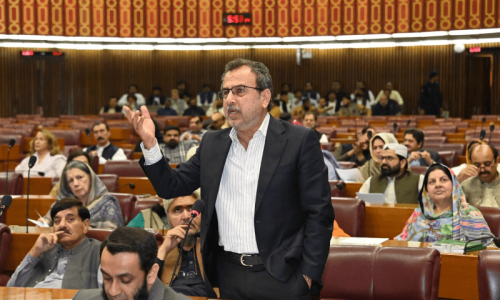
ISLAMABAD, April 20: Legendary left journalist and political historian Abdullah Malik who died this month five years ago was remembered by a galaxy of his peers at a well attended seminar at the Pakistan Academy of Letters on Saturday evening.
Prof Khwaja Masud who presided over the meeting praised him for his deep insight into history and his relentless struggle for the rights of the down trodden.
The seminar was part of the national literary series that the Academy is organising to remember the great writers of our time.
Veteran journalists Hameed Akhtar and I.A. Rehman, close companions of Abdullah Malik sat with his son Kausar Malik with Iftikhar Arif, Academy chairman and poet and women’s rights activist Kishwar Naheed and left thinker Ishfaq Salim Mirza.
Others who spoke on the occasion were Umar Kausar Malik, Sajida Iqbal Malik and Tariq Warsi.
Prof Khawaja Masud who called Abullah Malik a many splendoured genius, said that he devoted himself to the fulfilment of the cause to which he remained committed to the end. He recalled the large number of books that he wrote on the issues facing Pakistan and the history of Punjab of which he had deep and vast knowledge. He said Abdullah Malik attributed the failure of a succession of governments due to the leadership’s’ ignorance of the history of their land.
Hameed Akhtar said that Abdullah Malik did not seek any favours or benefits even from those with whom he worked in the political field, despite the fact that he faced difficult times. He recalled that Malik respected everyone and always added the word “Jee” to every name. He had a great sense of humour and enjoyed teasing the high and the mighty, not excluding his best friends.
I.A. Rehman in his address told the audience what Abdullah Malik thought was the reason behind the crises Pakistan faced. This was the decline of the Muslim League. He said that Abdullah Malik’s book Tareekh Nigari Aur Tareekh Fehmi was a must read for all political commentators. He said Abdullah malik was a very organised person. He devoted many hours daily to writing and yet did not miss any of his other multifarious activities.
Kishwar Naheed described Abdullah Malik as her mentor in politics. She read passages from one of his books that described his experiences of Hajj and other events of his life. She said she had closely worked with Abdullah Malik on the paper Ehtisab which is regarded as a model of resistance literature at a number of academia abroad.
In his address, Iftikhar Arif, Chairman, Pakistan Academy of Letters, said Abdullah Malik was among those scholars and men of letters who commanded wide respect among all sections of thought. He was one of the renowned leaders of the Progressive Writers’ Movement. Iftikhar Arif said as a journalist and progressive writer Abdullah Malik would always be remembered for his great strength of character and knowledge.
“His career is spread over a period of more than six decades, during which period, he published around 30 books and 100 columns and articles on history, culture, politics and the pressing issues of the third world.
He said Malik also remained active in various South Asian movements and even in his lifetime he had become an international figure as a human rights activist. Some of his important works are considered useful reference works for scholars and research workers. These included Bangali Mussalmanon ki Sad Sala Jaddojehdi-i-Azadi, Punjab ki Siyasi Tehriken, Daastan-i- Darorasan, Hadis-i-Dil, Jhota Muqaddama Sacha Mulzim.
Dr Kausar Abdullah Malik described his father, Abdullah Malik as an institution in his self, adding that as a journalist he faced many difficulties and spent many years behind the bars. He remembered what he called his dialectical approach to ideas. He said that during his last days, when the war on Iraq was imminent, Malik used to be greatly perturbed about it. He said that he had over 5,000 books in his personal library which included valuable manuscripts. He had the complete file of Lail-o-Nihar and other such magazines.
Ashfaq Saleem observed that a writer can be best judged by his writings. He said Abdullah Malik always chose the current issues to comment on. He read his paper on Abdullah Malik’s three books on the army.
Sajida Iqbal Malik said that Abdullah Malik was a very loving and caring person. He always remained very concerned about his children, she added.
Omar Kausar Malik said that his grandfather Abdullah Malik had a versatile personality and remained very friendly with people.
In his remarks Tariq Warsi also paid tributes to Abdullah Malik’s great knowledge from whom many journalists had learned a great deal.