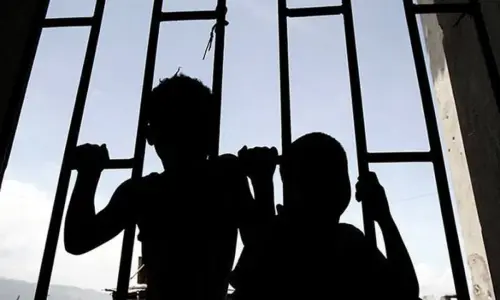
ISLAMABAD, May 30: Pakistan has virtually become a nation of dropouts where 45 per cent of students quit going to school at some stage, according to Federal Education Minister Lt-Gen (retired) Javed Ashraf Qazi.
“Over the years, we have failed to provide basic facilities at school level which is one of the factors behind the increasing rate of dropouts,” the minister told a national conference on the state of education in the country which opened here on Tuesday.
Of all the school-going age children in the country, 40 per cent do not attend school or have no school to go anyway.
Poor pay structure of teachers and lack of training facility for them were cited as other factors responsible for the less than 50 per cent literacy rate in the country.
“A teacher gets less pay than a domestic servant. It has become the profession of leftovers. We have to invest in the education sector,” the minister argued.
His ministry was trying to get the current federal spending of 2.7 per cent of GDP on education increased to the Unesco- mandated 4 per cent.
About 150 delegates from all over the country are attending the two-day conference organised to evaluate the deficiencies in the current National Education Policy (1998-2010) and to make it responsive to the needs of the modern world.
Successive governments had made a mockery of the education system, lamented the minister. “There is no uniformity at all, be it curriculum or the examination system. People are demanding examination boards even at district level,” he said.
A team constituted in September 2005 to review the Education Policy 1998-2010 will take two years to complete its work as the policy was not in consonance with the developments in the sector and needed a major assessment, the team leader Javed Hassan Aly informed the conference.
All the stakeholders, including the provinces, would be consulted in the review process to produce a consensus document, he said.
International Islamic University Rector Dr Manzoor Ahmad criticised commercialisation of education and called for broad- based education for everyone in the initial 12 years.
In 2004, private schools accounted for 42 per cent of the total enrolment in the country, a figure which most likely would have increased since.
“We have duality of education system, dearth of trained teachers, tension between centre and the provinces and uncalled for political influences which need to be done away with and uniformity to our education system,” said Dr Manzoor.
“Our education system makes a student to opt a certain subject too early which most of the time is the selection of the student’s parents,” he observed.
Over 20,000 schools in Punjab have no water, latrines, or proper classrooms etc., according to the federal education minister. “Almost the same number of schools in other provinces also suffer these problems, and at the end of the day only two per cent students join universities.”
“We have to take stock of things, through a consultative process. The conference is part of the efforts the government is making to revamp entire education system in the country,” the minister underlined.
Senate Chairman Mohammedmian Soomro told the conference that the country had to pay a heavy price for being left behind in the comity of nations by neglecting to provide quality education to its citizens.
“There is no dearth of talent in the country. It only needs better coordination of efforts both at federal and provincial levels,” he said.
The review of the current Education Policy 1998-2010 has been divided into preparation of the consultative roadmap in partnership with the provincial governments; and a diagnostic stage to improve the understanding of the cause and contours of various problems in the education sector and formulating the policy document, according to the review team leader.
A White Paper would be formulated and disseminated among all the stakeholders for comments and feedback, which would then formally be changed into policy paper to be presented to the government for approval, he said.
The policy paper would set forth broad parameters, goals and objectives, which would be based on realistic assessments of the identified resources, he added.