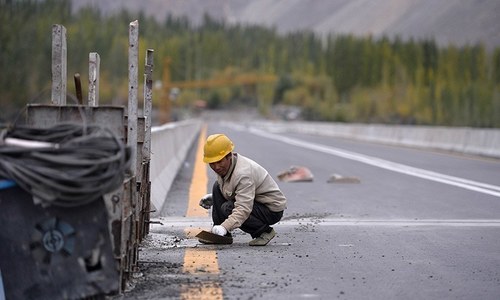
The Chinese government has decided to invest $24.8 billion (170bn yuan) into laying a highway network in the Muslim-majority Xinjiang region for improved connectivity with Pakistan.
The autonomous region will use the funds this year ─ up nearly six fold from 2016 ─ for building roads so it can better serve as China's trade hub by linking countries along the Silk Road Economic Belt.
New infrastructure projects are also expected to bring more job opportunities for locals, the region's top economic planning official said.
The region has never seen such a huge investment in road construction, Zhang Chunlin, director of the Xinjiang Development and Reform Commission, said in an exclusive interview in the regional capital of Urumqi.
The region will also invest approximately $1.18bn (8.1bn yuan) in the construction of railways and $0.7bn (4.8bn yuan) in civil aviation projects, both up by 50 per cent from last year.
The investment in building roads, railways and airports this year will oustrip the total funding for transportation infrastructure from 2011-2015.
Building a highway network in a region that takes up one-sixth of China's territory is a priority, Zhang said.
Currently, about 40pc of the cities and counties in Xinjiang are not connected by highways.
“Without the highways, oil, coal and agricultural products of Xinjiang cannot be shipped out of the region smoothly and logistics costs will remain high,” Zhang said.
After the planned highway network is completed, logistics costs in the region can be reduced by 30pc, he added. The region plans to start construction this year on 6,096 kilometres of highways.
Although poor infrastructure has been holding back development in the region, Xinjiang now sees opportunity for economic growth, he said.
Massive transportation projects can use significant amounts of steel and concrete, which can help to stimulate economic growth. What's more, locals can fill the jobs created by those projects, he added.
Currently, there is one highway linking Xinjiang and other parts of China to the east.
The roads currently connecting the region and China's neighbours to the west cannot meet the demands of future trade.
Zhang believes that without the support of transportation, becoming the trade hub on the Silk Road Economic Belt is not feasible, so Xinjiang must face the challenge head-on.
The central government sees Xinjiang, which borders countries including Kazakhstan, Pakistan and Mongolia, as a key trade centre for the economic belt.
The economic belt, part of the One Belt One Road Initiative proposed by President Xi Jinping in 2013, aims to revive the ancient trade route.
Xinjiang also plans to begin research on a high-speed railway connecting Urumqi and Horgos, a land port on the China-Kazakhstan border. Additionally, Urumqi International Airport will be expanded to cope with surging domestic and international traffic.