Karachi's ‘faulty’ road designs causing over 10,000 accidents every year

KARACHI: Despite some improvement brought about by civic agencies to minimise the risk of traffic accidents, faulty road designs remain one of the major factors contributing to mishaps that need to be effectively addressed in the development and rehabilitation drive continuing across the city these days, experts told Dawn on Tuesday.
The faulty road designs were responsible for 35 per cent accidents out of the total 30,000-32,000 road accidents taking place every year in the city, they said.
“This [ratio] translates into at least 10,500 accidents every year. It’s a huge number. We believe that this issue should be addressed in the current road development works being carried out in the city,” said Prof Mir Shabbar Ali, the head of the department of urban and infrastructure engineering of the NED University of Engineering and Technology.
According to him, the most important factor in faulty road designs in the case of Karachi is the removal of service lanes, which force drivers to opt for travelling on the wrong side of the road.
Road safety, he said, was equally important as road efficiency and there was a dire need for the officials concerned to give it due importance.
Studies carried out by NED University had shown that wrong-way driving alone caused 25pc (7,500 cases) accidents every year, he added.
“While the government is investing billions of rupees in road development and rehabilitation, it’s the right time that this problem is addressed, too,” he observed.
Risky U-turns
Pointing out another factor relating to the flawed road designs, Dr Salman Zubair of Karachi University’s geography department said that results from his 2015 study indicated that U-turns with medians were causing more accidents than those without medians.
“Out of the 120 U-turns examined in the city, 87 were without medians and 33 were with medians. After interviewing people living or operating their businesses in the vicinity, we came to the conclusion that more people suffered accidents who attempted to use U-turns with medians located on busy roads,” he said, sharing findings of the study.
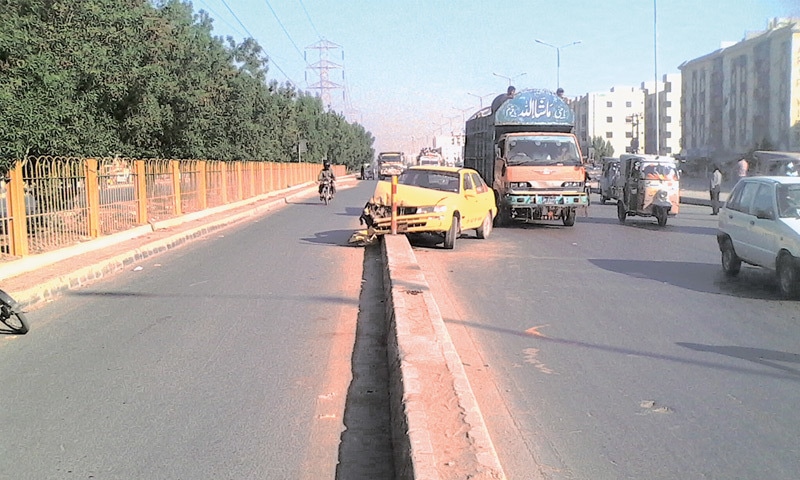
These poorly designed medians, he said, were often found without reflectors, broken at some points, suggesting a crash had occurred at least once.
Recently, he said, the civic agencies had removed two to three medians at U-turns at some places but they still existed in areas like the old Sabzi Mandi, North Karachi, North Nazimabad and on Shaheed-i-Millat Road.
“I think the government should take urban engineering experts on board to make medians safe at U-turns. Right now, they are very risky because they lack indication, warning the driver of the concrete divider ahead,” he said.
Often, he observed, vehicles crashed into the medians at U-turns.
“I think it’s better to remove them completely since the public lacks road sense and the government is least bothered about the risks poor road designing poses to people’s lives,” he said.
Citing data from some other studies, he said urban road crashes were a growing public health and safety problem both in the developed and developing world.
“Pakistan stands first in Asia and 48th in the world in this regard whereas Karachi ranks fourth in the list. Multiple factors are responsible for these crashes that include error on part of road users,” he said.
He strongly recommended use of remote sensing and geographical information system techniques in road planning and design. “This will not only save our resources but also many lives,” he said.
Published in Dawn, February 1st, 2017