0
0

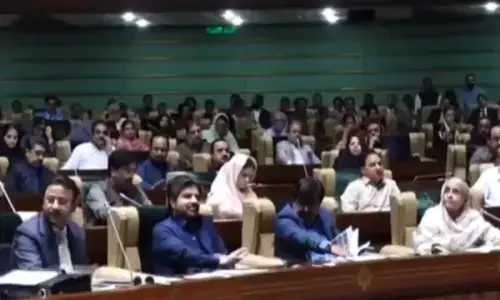
PESHAWAR: A Peshawar High Court bench on Wednesday issued notices to the Khyber Pakhtunkhwa government and provincial Assembly’s speaker seeking their comments on a petition challenging the government’s move to end applicability of different labour laws, including the one about the minimum wages, to the private educational institutions in the province.
Justice Waqar Ahmad Seth and Justice Roohul Amin Khan Chamkani directed the petitioner, Saleem Shah Hoti, to submit the list of lawmakers running educational institutions in the province.
The provincial advocate general was also told to assist the court on the matter.
The petitioner requested the court to strike down the relevant amendments to the laws by declaring them illegal and unconstitutional.
PHC orders production of list of lawmakers running private educational institutions in the province
Mr. Hoti filed the petition in the larger public interest saying private educational institutions across the province have been subjecting teachers to the worst form of exploitation but they’ve been removed from the purview of the labour department for being owned by several lawmakers.
The respondents in the petition are the speaker of the Khyber Pakhtunkhwa Assembly, the provincial government through chief secretary, provincial law secretary, provincial advocate general, and chairman of the ruling PTI Imran Khan.
Mr. Hoti contended that there was no law in the province to regulate private educational institutions, especially the salary of teachers and working conditions for them.
He pointed out that last year, the provincial assembly had passed The Khyber Pakhtunkhwa (Amendment Laws) Act 2015 through which different amendments were made to different labour laws, including the Khyber Pakhtunkhwa Payment of Wages Act 2013, the Khyber Pakhtunkhwa Industrial and Commercial Employment (Standing Orders) 2013, the Khyber Pakhtunkhwa Minimum Wages Act 2013 and the Khyber Pakhtunkhwa Industrial Statistics Act 2013.
He said after those amendments, the labour laws in question no longer applied to private educational institutions in the province.
Mr. Hoti said after the enforcement of the Constitution (Eighteenth Amendment) Act 2010, the four labour laws in question were passed in the province in 2013. He added that the provincial legislature had passed those laws for the welfare of the workers associated with private sector institutions and units.
The petitioner said those laws were meant to regulate the minimum wages to certain classes of persons employed in factories, industrial establishment and commercial establishment, regulate the payment of wages, provide for regulation of industrial and commercial employment in the province, and facilitate the collection of statistics of certain kinds relating to factories, and industrial and commercial establishments.
He claimed the minimum monthly salary had been fixed at Rs13,000 in the province but the private educational institutions had employed highly educated and qualified male and female teachers and ancillary staff members for few thousand rupees, which was both disrespectful and insufficient for them.
The petitioner said in several private educational institutions, the staff members hadn’t been paid salary during summer and other vacations, an act of sheer injustice and exploitation.
He said the labour department had launched a campaign to collect the statistics of private educational institutions in the province and carry out their inspection to address the grievances of the people and staff members. However, following the controversial amendments the labour department had no authority to check these exploitations.
The petitioner claimed that the assembly’s speaker and other lawmakers from the government side owned educational institutions due to which the impugned amendments were made.
Published in Dawn, December 1st, 2016