In what has been unravelling like a game of whack-a-mole for the state and the disturbing array of militant groups spread across the country, there seems to be no clear end in sight.
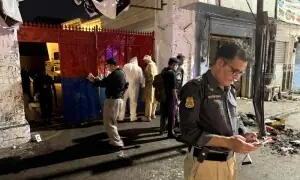
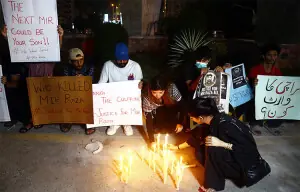
On Oct 24, Quetta’s air was once again echoing with the sound of ambulances as armed militants successfully infiltrated the city’s police training academy, killing 62 young men.
The attack on Quetta’s police academy is part of a series of attacks in Pakistan’s urban centres staged by the Lashkar-i-Jhangvi Al-Alami group in collaboration with the militant Islamic State (IS) group.
Al-Alami, a splinter group of the Lashkar-i-Jhangvi, was quick to claim responsibility for the attack and pictorial evidence floated by the group on social media suggested that IS-Khorasan may have provided individuals to be part of group of attackers.
In the global fight against terrorism, unlikely alliances between militant groups have been a regular feature and the Islamic State, cornered in the Middle East, is finding newer allies in this part of the world.
What does the LJ and IS-Khorasan collaboration mean for militancy in Pakistan and what does it represent?
“The LJ is no longer simply a sectarian group targeting Shias in Pakistan,” explained Hasan Abdullah, a journalist and security analyst. “Its interaction with groups like Al Qaeda has influenced its world view. It has collaborated with different militant groups not just in Pakistan but even in Afghanistan and these groups have provided each other technical and logistical support,” he added.
Tariq Khosa, former inspector general of police, explained that the LJ spawned splinter groups when the Pakistani authorities decapitated its leadership in July 2015. “Its Balochistan faction,” he pointed out, “is working with ISK while its Karachi faction continues to be affiliated with Al Qaeda in the Indian Subcontinent (AQIS).”
In the global fight against terrorism, unlikely alliances between militant groups have been a regular feature and the IS, cornered in the Middle East, is finding newer allies in this part of the world.
Tariq Habib, a reporter who has kept a keen eye on militancy in Balochistan, spells out a key factor in determining intra-militant allegiances. “While various militant factions characterising extremism in Pakistan might have subtle differences in their approach towards ‘jihad’, they are strongly bound together by a common enemy: the state of Pakistan.
“They use each other’s help wherever they can,” explained Mr Habib, adding that Balochistan, due to the general weakness of the state’s apparatus, has become a soft target for a well-funded IS to carve inroads into.
This is not the first time Al-Alami and IS-Khorasan have colluded to orchestrate attacks. In July this year, the two groups carried out a joint suicide bombing that killed 80 Hazaras in Afghanistan. IS-Khorasan is also known to have collaborated with Jammatul Ahrar to carry out the Quetta hospital bombing in August this year.
“As a part of a new strategy, it is clear that IS has seeded a nucleus in the Af-Pak region. It is likely to grow in size, strength and influence across the South Asian borders. Its sheer brutality and anti-Shia agenda is likely to sustain momentum and further spread in Pakistan,” stated Mr Khosa.
Pakistani authorities would have to pull all the strings they can to counter at the imminent threat of local militancy going global.
Stressing that inconsistencies in the government’s counterterror strategies have done more harm than good, Mr Habib said that the LJ had also enjoyed the state’s “good Taliban” status in the past — something that had surely strengthened the militant outfit.
Published in Dawn, November 2nd, 2016