ISLAMABAD: Despite Indian conspiracies, the size of the China-Pakistan Economic Corridor (CPEC) has been increased to more than $51.5 billion after China and the Asian Development Bank (ADB) agreed to lend $8bn to upgrade the main railway line from Karachi to Peshawar, according to a federal minister.
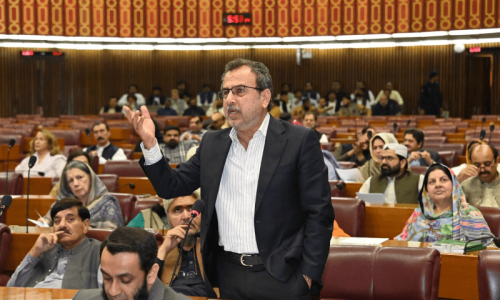
Addressing a news briefing upon his return from a week-long visit to China, Minister for Planning, Development and Reforms Ahsan Iqbal said Beijing has agreed to provide Pakistan with a $5.5bn concessional loan to upgrade and modernise the Karachi-Lahore main railway line called ML-1.
In addition, ADB will extend financing of $2.5bn for the Lahore-Peshawar railway track, he said.
Read: Russian researcher says CPEC ‘game-changer for the region’
“Both loans will carry less than 2 per cent interest rate. Both are concessional loans,” he said. However, he declined to discuss specifics of the lending programme, saying the Economic Affairs Division is still busy finalising the terms and conditions.
He said the original $46bn CPEC included about $3.56bn financing for the railway network, which has now increased to $8bn. “This is ad add-on” to the original CPEC, he explained.
He said the Karachi-Peshawar railway line processed 75pc of the passenger and cargo traffic, but its efficiency has dropped to 60-80 kilometres per hour. That is because of a continuous deterioration during the long tenure of former president Pervez Musharraf, he said, adding that the track, signalling system and bridges were in bad shape.
The refurbishment and upgradation of the main line will cost $8bn and take five to six years to complete. This will revive its efficiency to 120-160 kilometres per hour. It will be upgraded in a manner that it will accommodate fast-moving trains, reduce the cost of production and increase the competitiveness of Pakistani products.
The main line will then be expanded in the next phase to link Gwadar with Peshawar and then Havelian, Abbottabad, with Khunjerab.
Mr Iqbal said the CPEC has three phases and four major areas, namely Gwadar Port’s development, energy projects, road networks and industrial cooperation. The short-term, medium-term and long-term projects will complete by 2020, 2025 and 2030, respectively.
At present, work is in progress in the first three areas of infrastructure development, which will enable the two nations to push for industrial cooperation, he said.
Mr Iqbal said both sides agreed to convene the 6th Joint Cooperation Council (JCC) of the two countries in the last week of November. Before the JCC, working groups on transport, Gwadar Port and industrial cooperation will meet next month to firm up the implementation plan.
He said the long-term industrial cooperation has been finalised in Pakistan in consultation with all provinces, Azad Jammu and Kashmir and Gilgit-Baltistan. He said the four chief ministers belonging to different political parties have supported the CPEC that will be funded through the public-sector development programme, Chinese financing and funding by multilateral agencies.
Responding to a question, Mr Iqbal said some people have created misconceptions about the CPEC, adding that the federal government has invited the leadership of the Awami National Party for a briefing next week to address their concerns.
India has launched a massive campaign in the media to mislead people about the CPEC, he said. He noted that CPEC projects of about $18bn are currently in the implementation phase while another $17bn worth of projects are in the active pipeline. This means $35bn worth of projects have already been energised in just two years.
Published in Dawn, September 30th, 2016