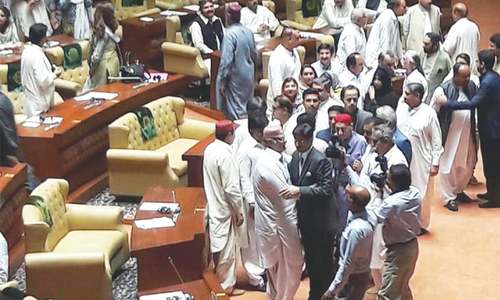
KARACHI: The newly appointed chief minister of Sindh began his first day in office Saturday by ordering the removal of barriers and encroachments erected around the CM House in Karachi.
Sworn in as the top provincial government representative just yesterday, Murad Ali Shah earned praise today for his decision to remove barriers that stood as a familiar part of the CM House security structure.
Shah said as a public representative, his job was to facilitate the masses and not cause problems for them.
Several concrete barricades could previously be seen along one side of the thoroughfare that passes outside the CM House on Karachi's Dr Ziauddin Ahmed road, often congesting traffic – especially in rush hours.
Barricades in the street leading to the CM house will also be removed, DawnNews reported.
The road is often blocked for the public during VIP movements and security threats. But on Saturday, lifters could be seen removing concrete barriers from outside the CM House.
Reports suggest Shah is also in talks to trim the number of police cars used in the CM's official protocol.
‘I will be in office at 9am’
Speaking after being elected to lead the house on Friday, Shah said he had three priorities as the chief executive: "Serving the public, serving the public, serving the public".
Shah promised a renewed drive against corruption in the bureaucracy.
"Those who know me, know that I wake up at 8am and reach my office at 9am. Today is Saturday, so (bureaucracy) is safe. From Monday, I will be in office at 9 and those who arrive late will see,” said Shah.
"Alone I can go fast, together we can go far," Shah said demanding support from his fellow lawmakers.
Murad Shah: Profile
Murad Ali Shah was born on Nov 8, 1962, in Karachi. He was schooled in Karachi where he bagged his engineering degree from the NED University of Engineering and Technology.
He got a job of junior engineer in the Water and Power Development Authority (Wapda), engineer at the Hyderabad Development Authority and later worked as executive engineer at the Port Qasim Authority. He was also a project director of the fish harbour authority.
Then he left for the US where he assumed masters degrees of engineering-economic system and civil and structural engineering from Stanford University in the 1990s.
He contested and won the constituency of his father – Abdullah Shah – from a small town of Jhanghara in 2002 general elections, now in Jamshoro district, and became an integral part of PPP’s think tank to analyse and oppose the provincial government backed by the then military ruler Gen Pervez Musharraf.
His increasing interest in financial matters and rules of business of the assembly won him key position in the party, which paid dividends in the latter years when the PPP formed its government in Sindh.
After winning the same constituency in 2008 he was made the minister for irrigation in Syed Qaim Ali Shah’s first stint as the chief minister. Later, he got the portfolio of the finance ministry that he had been overseeing till his election as the CM.
In 2013, he was disqualified from the assembly seat for holding dual nationality. He surrendered his Canadian nationality and contested the elections again though he remained adviser to the chief minister for finance during this period. He finally assumed his ministry after winning the by-election in 2014.