ISLAMABAD: Pakistan and the United States blamed each other for strains in bilateral ties, yet both sides managed to show their conciliatory side during high-level meetings here on Friday.
While Pakistani officials accused the US of violating the country’s sovereignty by carrying out a drone attack in Nushki last month, disregarding their security interests and undermining the Afghan peace process, a visiting American delegation pointed to the continued presence of Taliban and Haqqani network sanctuaries on Pakistani soil because of what it called inadequate action by security forces against them.
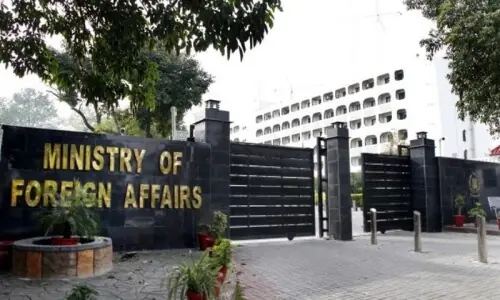
The accusations were exchanged during the two meetings that the US delegation had at the Foreign Office and the General Headquarters.
Upset by Nushki drone strike, Islamabad conveys strong message to American officials
The US delegation comprised Special Envoy for Afghanistan and Pakistan Ambassador Richard Olson and Director for Pakistan and Afghanistan at the US National Security Council Dr Peter Lavoy.
The US team was here on an assessment-cum-fence-mending mission after the strains in bilateral ties became too obvious to miss. Gen John Nicholson, Commander Resolute Support Mission in Afghanistan, joined the duo during their visit to the GHQ.
The two meetings were described by an official as ‘cold’ with the one at the Foreign Office lasting for about half an hour. An FO statement described the discussion, which focused on the Nushki drone strike and its fallout, as ‘candid’.
Adviser to the Prime Minister on Foreign Affairs Sartaj Aziz, the FO said, “conveyed a strong message” over the drone strike that violated Pakistan’s sovereignty and vitiated bilateral ties. He said the May 21 drone strike was also a breach of the principles of the United Nations’ Charter.
He warned that “any future drone strike in Pakistan will be detrimental to our common desire to strengthen relations”. Pointing to the surge in violence in Afghanistan after the Nushki attack in which then Afghan Taliban chief Mullah Akhtar Mansour was killed, Mr Aziz reminded the US about the setback caused by the attack to the reconciliation efforts.
A similar sense was conveyed when the delegation met Army Chief Gen Raheel Sharif at the GHQ.
The army chief told the American officials that the drone strike had affected “mutual trust and respect” and damaged the move to consolidate the gains of Operation Zarb-i-Azb.
The American side responded to Pakistani allegations by pointing to the presence of Taliban and Haqqani network sanctuaries on Pakistani soil. They, in particular, made references to the death of Mullah Mansour on Pakistani soil and recovery of his Pakistani identity and travel documents. They told their Pakistani interlocutors that the presence of Taliban and Haqqani network on Pakistani soil threatened not only Pakistan, but also the region and the US national security interests.
The US has maintained this position in dialogue with Pakistan for over a year now and American officials describe the issue as a “real challenge” in the relationship.
The US defence secretary has, meanwhile, been withholding a certification to the Congress that actions by Pakistani security agencies in tribal areas have seriously impacted the operational capability of the Haqqani network.
Pakistani officials insist that their security agencies have indiscriminately targeted all militant groups.
Three-point demand
Pakistan, which had previously been linking any action against the Taliban to a consensus within the Quadrilateral Coordination Group (QCG), has now presented a three-point demand for any progress towards reconciliation or action against the alleged sanctuaries, which include tightening border controls; early repatriation of over three million Afghan refugees; and action against TTP [Tehreek-i-Taliban Pakistan] operatives in Afghanistan.
These ideas do not exactly sound new, but have been articulated in this manner for the first time.
“These steps would help ... promote better relations between Afghanistan and Pakistan and reduce mistrust,” the FO said.
Gen Raheel Sharif told the American visitors that censuring Pakistan for Afghanistan’s security woes was wrong. He called for a comprehensive review of the situation by taking into account the porous border, inter-tribal linkages and decades-old presence of over 3m Afghan refugees in Pakistan.
He demanded action against banned TTP chief Mullah Fazlullah and TTP sanctuaries in Afghanistan and vowed to foil plots of Indian and Afghan intelligence agencies — RAW and NDS — to foment terrorism in Pakistan.
Dr Lavoy, according to the FO, reiterated President Barack Obama’s commitment to improving relations with Pakistan.
Gen Sharif, meanwhile, renewed Pakistan’s pledge to work for a long-term peace in Afghanistan under the QCG framework.
According to APP, Dr Lavoy also conveyed President Obama’s good wishes for Prime Minister Nawaz Sharif’s speedy recovery.
Published in Dawn, June 11th, 2016