TEHRAN: Tehran resident Sousan Heidari has stopped letting her headscarf slip casually down over her neck and shoulders while driving in the Iranian capital. These days, the 22-year-old with a taste for bold makeup makes sure to pull it tightly over her dark hair, fearful of running afoul of a newly established undercover division of the morality police.
"Every single man or woman could be a member of the unit," she cautioned. "I don't know. Maybe some plainclothes have already reported me because of heavy makeup."

Tehran police chief Gen Hossein Sajedinia recently announced his department had deployed 7,000 male and female officers for a new plainclothes division ─ the largest such undercover assignment in memory.
Authorities say the division, which started work last week, will patrol major Tehran streets and intersections, policing transgressions including harassment against women and excessive car honking and engine noise.
Critics fear the unit's main focus, however, will be enforcing the government-mandated Islamic dress code, which requires women be modestly covered from head to toe.
They see it as the latest flashpoint in the struggle between relative moderates such as President Hassan Rouhani and establishment hard-liners who fear looser social norms will weaken the Islamic Republic's values and principles.
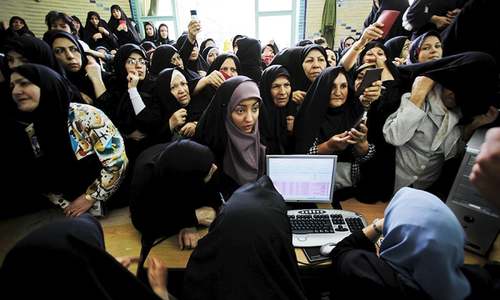
Iranian women these days, particularly younger ones, often forego the traditional long black long veil known as the chador and opt instead for trendy dresses and fashionable headscarves. More and more, they are daring to let their scarves slip down to their shoulders while driving.

Influential ayatollah Mohammad Ali Movahedi Kermani alluded to those concerns about moral erosion during a recent Friday sermon in Tehran, saying that a woman driving without a veil "cannot be called freedom".
Avoiding sartorial trouble in Iran has been fairly straightforward up until now. Police assigned to the morality-enforcement beat normally wore the same dark green uniform of regular Iranian police, and were stationed out in the open at major squares and crossroads.
They would take a range of approaches to enforcing dress codes, including handing out scarves as gifts, giving verbal warnings or having female officers physically remove excessive makeup.
At worst, offenders would be sent to court and face fines of up to $250 or hauled to the local police station until their family members gave a written promise that they would never commit the same offense again.
Azizeh Shirazi, a mother of two college-aged daughters, said last week's announcement of the new force has left her worried that something might happen to them on the way to university. "When the girls do not answer my phone calls during the day, my heart beats faster," she said.
The outcry over the new undercover police force extends to senior officials.
Shahindokht Molaverdi, vice president for women and family affairs, criticised the decision and expressed concern that it would be "limited to giving warnings to women over improper attire", according to local media reports.
Molaverdi said many citizens have complained to her about the police decision, and she vowed that the Rouhani administration will review the proposed force.
Even the popular Hamshahri daily, which is linked to conservative opponents of Rouhani's government, raised questions about the plan in an editorial, asking why it was necessary now and whether there would be any way to verify the unit's reports.

Police responded to the criticism by saying that "demands by the people" led to the creation of the new unit and that concerned citizens could contact police about any ambiguities.
They have found support from hard-liners, including female parliamentarian Fatemeh Rahbar ─ who said the previous practice of uniformed morality police was too easy for violators to spot and evade.
"The police are thinking about a more precise, more effective and more functional method since the previous open method did not bear fruit," she said.
On Sunday, the spokesman of the hard-line dominated judiciary, Gholam Hossein Mohseni Ejehi, added his voice of support, saying the "judiciary definitely supports the police plan to confront open social corruption".
Tehran-based political analyst Saeed Leilaz believes the new unit is a reaction to the resounding defeat of hard-line and conservative candidates in Tehran during recent parliamentary elections.
A bloc led by moderates and reformists won a majority of seats around the country, but captured all 30 seats representing the capital in the 290-seat parliament. A runoff election for 68 remaining undecided seats will be held Friday.
Leilaz noted that these new plainclothes units have only been announced for Tehran, not for any other major Iranian city.
"This is part of the establishment's reaction toward Tehran residents' attitude in the election," he said. "It's an expression of discontent and taking revenge, as well as applying efforts in restricting President Rouhani."
Leilaz said the new initiative suggests previous hard-line dress code policies have failed. And he questioned how effective the new division would be.
"The plan, as usual will have a short-term limited impact. Soon people will return to their routines," he said.