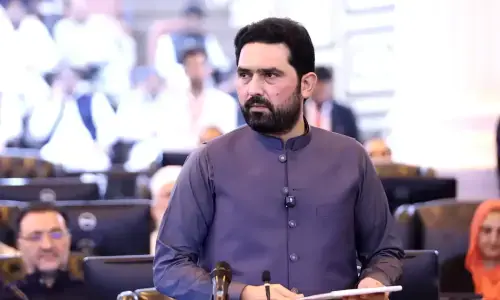
MINGORA: A number of civil society activists in Swat on Sunday marked the death anniversary of the renowned social worker, Parveen Rehman, who was murdered near her office in Orangi Town, Karachi, on March 13, 2013.
They also urged the Supreme Court to accelerate proceedings in the case to bring her killers to justice.
Highlighting different aspects of Perveen Rehman’s life at a gathering, Fazal Noor, a social worker, said that she wanted to work for the marginalised communities for which she quit her job and joined the Orangi Pilot Project run by Dr Akhtar Hamid Khan.
“She challenged the well-off societies and started installation of underground gutter line for poor communities as carried out in planned societies. She did it by involving poor communities after motivating them to work in unity,” he said.
Civil society activists urge SC to bring her killers to justice
He said that Ms Rehman fought with influential mafias with smile on her face. “She mobilised the poor communities towards their equal rights as enjoyed by rich, and she remained successful in her endeavours,” he added.
However, he said that she was killed in daylight, but her killers were yet to be brought to justice.
Shaukat Sharar, a social worker in Swat, said he got inspiration from Ms Rehman when he was her student. “When I completed my studies and returned home, I along with other friends established the Environmental Protection Society to work for environment in Swat,” he said, recalling that she was soft spoken, well-mannered and brave. Mohammad Roshan, a civil society activist, said that the mafias which killed Ms Rehman existed everywhere in the country as influential land and timber mafias worked in Swat openly.
The participants said that it was the state’s responsibility to eliminate all kinds of mafias from the country. “Unfortunately, there are elements in the state institutions who are involved with mafias which make them too stronger to be tackled by common people,” said Talimand Khan, a researcher. He added that Parveen Rehman had become a symbol of positive change.
Hazer Gul, another social activist, questioned the silence of the Sindh government over the murder of Ms Rehman. “If Salman Taseer’s killer can be brought to justice why not Parveen Rehman’s? They should be brought to justice,” he said. “This gathering of people here in Swat to raise voice against the antisocial elements shows that people who think positive still exist,” said Fazal Maula Zahid.
The participants passed a resolution, urging the Supreme Court to accelerate proceedings in the case of Ms Rehman to bring her killers to justice.
Published in Dawn, March 14th, 2016