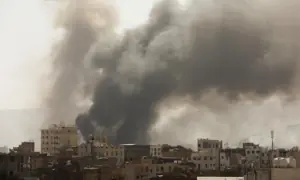
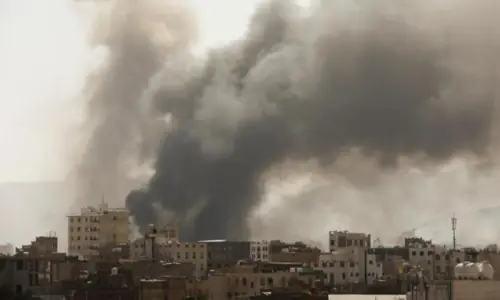
KABUL: The Taliban attacked a police headquarters and an intelligence agency office on Wednesday in Afghanistan's southern Helmand province, where the insurgents have been battling government forces for months.
At least three police officers were killed along with seven attackers, said Jabbar Karaman, a lawmaker appointed by President Ashraf Ghani to investigate the situation in Helmand.
Omar Zwak, a spokesman for the provincial governor, said the attack on the intelligence facility was repelled.
The Taliban claimed responsibility for the attack in Helmand, a major poppy-growing region where insurgents have been battling government forces as well as fighting among themselves over smuggling routes.
Afghan forces have struggled to combat the Taliban since the US and Nato formally concluded their combat mission at the end of 2014, and the insurgents have spread their footprint across the country.
The independent Afghanistan Research and Evaluation Unit, a local think tank, meanwhile said the army has suffered from the theft of assets, disloyalty among troops, as well as poor equipment and logistics.
Its report said a "culture of dependence" pervaded the army, left over from years in which international troops provided air cover and logistical support.
The weaknesses have been brutally exposed in Helmand, which has seen little of the winter lull that brings relative calm to other areas. The army is struggling to develop an offensive capacity, which it has lacked throughout the 15-year war, when US and British troops took the fight to the insurgents.
Both the United States and Britain have sent reinforcements to the region under their new training and advising mandate.
The Afghan government is hoping for a direct dialogue with the Taliban this month, with the aim of eventually holding peace talks, but the Taliban have said they will not participate.
Related: Afghan govt still willing to negotiate with Taliban
The peace process was derailed last summer, when Kabul revealed that the Taliban's founder and leader, Mullah Mohammad Omar, had been dead for more than two years.
The head of the US Central Command, Army General Lloyd Austin, told the Senate Armed Services Committee this week that Afghanistan has been a "very challenging environment" for the past year.
He cited the change of government in late 2014,the reduced international military footprint, and the death of Mullah Omar, which "caused the Taliban to fracture a bit" while giving rise to a new leader — his deputy Mullah Akhtar Mansoor — "who set out to prove himself with increased activity."