THE complexity of the challenge confronting the Muslim world where dealing with religiously inspired militancy is concerned has been aptly demonstrated by a series of recent events.
The latest crisis emerged in Jakarta, where elements linked to the militant Islamic State group went on the rampage on Thursday.
A news outlet connected to the group claimed responsibility for the carnage, while Indonesian police also said they believed IS was behind the attacks.
Meanwhile, on Wednesday, IS claimed responsibility for the attack on the Pakistani consulate in Jalalabad, Afghanistan, while Turkish authorities said the individual responsible for the Istanbul bombing on Tuesday was an operative of the militant group.
These events show that nearly all Muslim states — despite geographic, cultural and political differences — are vulnerable to violent religious extremism.
It would be incorrect to assume that a monolithic IS is planning attacks in Muslim countries — and elsewhere — based in Syria.
However, what is entirely possible is that the so-called caliphate is inspiring fringe groups and individuals across the globe to act in its name, or in support of its cause.
For example, in Indonesia IS doesn’t actually need a physical presence; militant groups such as Abu Sayyaf and Jemaah Islamiyah are ideologically on the same wavelength.
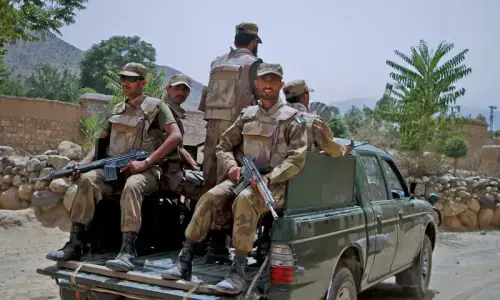
Pakistan faces the same predicament: Al Baghdadi and his men do not need to be physically present to forward their agenda.
There is a plethora of militant and sectarian groups that are arguably still active and more than willing to carry the IS banner in Pakistan. The same can be said of nearly any Muslim country, where a variety of factors have led to the growth of home-grown radical movements.
Unfortunately, some Muslim states have either looked away as extremist groups grew in size and strength in their backyards, while others have even used these as proxies in geopolitical conflicts. It is also true that most Muslim states — both authoritarian set-ups and democracies — have failed to deliver social, economic and political justice to their citizens, helping fuel the rise of radical movements, which want to destroy the ‘system’ and build it anew in their own image.
In the immediate term, the Muslim bloc should realise that the war against extremism and terrorism is ‘our’ war.
Firstly, there must be realisation within Muslim states that the militant tide has to be confronted, without differentiation between ‘good’ and ‘bad’ militants.
Secondly, a pan-Islamic effort is needed to clamp down on militancy, which can be achieved through joint counterterrorism efforts. However, any alliance built along sectarian or geopolitical lines is doomed to fail.
Moreover, Western involvement in such an endeavour should be avoided for two reasons: to prevent extremists from portraying it as a ‘war against Islam’, and the fact that much of contemporary Islamist militancy has been fuelled by Western intervention and regime change in Muslim states.
Published in Dawn, January 15th, 2016