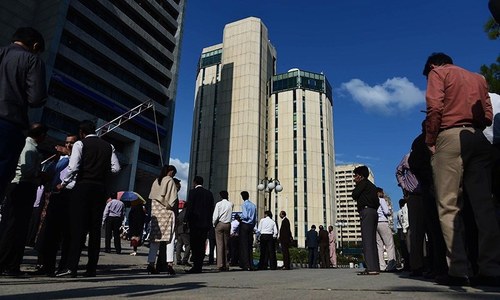
PESHAWAR: Strong earthquake jolts were felt in parts of Islamabad and Khyber Pakhtunkhwa (KP) on Friday.
The Pakistan Meteorological Department (PMD) said the earthquake magnitude was 5.9, with its epicentre in the Afghanistan-Tajikistan border region.
However, the United States Geological Survey reported the magnitude of the earthquake was 5.0 and traced its origin to the Jarm region in Afghanistan.
Explore: Earthquake intensity 8.1 or 7.5?
Residents reported that tremors were felt in Peshawar, Malakand, Mansehra, Haripur and Abbottabad.
Fear and panic spread among citizens, who left their homes and workplaces and ran onto the streets.
No casualties have been reported as yet.
This is the third quake reported to hit the northern areas since 2016 began.
These areas are still reeling from a strong 7.5 magnitude quake which struck in Oct 2015, killing over 300 people in both Afghanistan and Pakistan.
Read: Quake toll reaches 267, Nawaz announces relief package
Shangla, Chitral, Swat and Dir were among the worst-hit places in the region.
Related: Quake survivors endure crippling cold in the open
Many houses in the quake-affected areas were reduced to rubble and survivors have had to spend winter sleeping in the open ─ or in tents.
On Dec 25, 2015, over 30 people were injured as a 6.2 magnitude earthquake was felt in parts of Pakistan, Afghanistan and India.
Pakistan is located in the Indus-Tsangpo Suture Zone, which is roughly 200 km north of the Himalaya Front and is defined by an exposed ophiolite chain along its southern margin.
This region has the highest rates of seismicity and largest earthquakes in the Himalaya region, caused mainly by movement on thrust faults.
Along the western margin of the Tibetan Plateau, in the vicinity of south-eastern Afghanistan and western Pakistan, the South Asian plate translates obliquely relative to the Eurasia plate, resulting in a complex fold-and-thrust belt known as the Sulaiman Range.
Faulting in this region includes strike-slip, reverse-slip and oblique-slip motion and often results in shallow, destructive earthquakes.
The PMD recorded about 851 seismic disturbances in 2015.
Explore: Earthquake aftermath: Debris, death and destruction