0
0

THE Mona Lisa, the world’s most written-about and most expensive painting ever, is famous for its ‘enigmatic’ and ‘mysterious’ smile. It is often said that the portrait of the Mona Lisa conveys the impression of ‘great serenity’ and ‘harmony’.
Just as portraitists are expected to paint not only the apparent physical resemblance or be photographically realistic but to depict the real impressions about the inner personality of their subjects within a frame, it is expected of a writer of a pen sketch to uncover the hidden traits of a person within a few pages. Though that portrayal may or may not be accurate, a portrait painter and a writer of pen portrait must depict the impressions about the characteristics of the person they have chosen as the subject of their art.
A pen portrait, or pen sketch, is not an account of a person’s life as it is not intended to be a biography. Rather it aims at discovering the traits of inner personality in a lively, or at least, informal manner. Just like a profile painting, a pen sketch may draw the outlines or prominent features of a personality, describing the countenance. A good pen sketch ought to be concise, crisp and curious. It may be passionate but the writer must be fair and refrain from being too critical or negative. It does not mean, however, that a pen sketch should be flattering or excessively admiring. All these preconditions make pen sketch a genre difficult to master.
But pen sketch is a literary genre that has become quite popular in Urdu. The genre, known as khaka or khaka nigari in Urdu, owes much of its popularity to the informal and candid style that has now become the hallmark of Urdu’s literary pen sketches.
Some critics say that Muhammad Hussain Azad was Urdu’s first pen sketch writer as in his Aab-i-hayat on a number of occasions the portrayal of poets’ demeanour and eccentricities make it sound like a pen sketch. But in true sense Mirza Farhatullah Baig was Urdu’s first pen sketch writer. His sketch of his teacher Moulvi Nazeer Ahmed is a memorable one and reveals in a delectable style the real and living Nazeer Ahmed behind a sober and scholarly exterior, thereby fulfilling the basic requirement of a pen sketch. This sketch is both lively and pensive. The other sketch writers considered master practitioners of the art include Khwaja Hasan Nizami, Moulvi Abdul Haq, Rasheed Ahmed Siddiqui, Ashraf Suboohi, Chiragh Hasan Hasrat, Shahid Ahmed Dehlvi, Shaukat Thanvi, Saadat Hasan Manto, Muhammad Tufail, Mumtaz Mufti and some others.
Muhammad Hamza Farooqi is among the writers who have made valuable contribution to the Urdu pen portrait writing lately. Though Hamza Farooqi is more known for his research, especially on Allama Iqbal, Ghulam Rasool Mehr and Zafar Ali Khan — which at times is deeply rooted in the history of the subcontinent — he has been writing non-fiction prose, too, including travelogues and pen sketches. But there is a latent humorist in him as well, as is evident from some of his satirical and humorous pieces that have appeared in literary magazines. At times this latent humorist wakes up with a roar and takes over from the researcher. This can be seen in his travelogues, too.
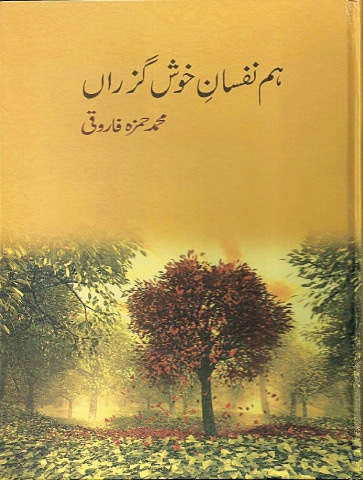
In Hmaza Farooqi’s new book Ham nafasan-i-khush guzraan, this humorist has come out quite forcefully. As a result, this collection of pen sketches has become informative as well as readable. Published by Karachi’s Academy Bazyaft, the book includes some pen sketches written as early as in 1980s. Some of the sketches — that of Ghulam Rasool Mehr, Shaukat Sabzwari and Basheer Ahmed Dar — written some 20 to 30 years ago, are somewhat serious, albeit not without their merits. But then begin the sketches written in quite a different mood and tone. Here Hamza Farooqi comes into his own and begins writing in quite an undeterred manner. Once he is done with the older scholars whom he respected much, his witty style is at times irreverent, though he stops just short of making any offensive remarks, as he knows that a pen sketch is not a caricature in which certain features and peculiarities are exaggerated, just to satirise or make fun of. His aim is not to spoof at these personalities and it is quite evident that he respects them all, as some were very close friends or senior writers. What he wants to say is that all of them were human beings and had little imperfections like everybody else, though they were extraordinary in many ways and great in one way or another. The other personalities whose pen sketches are included in the book are Ashiq Hussain Batalvi, Zafar Hasan Aybak, Saeed Shamil, Mirza Muhammad Munawwar, Shah Hasan Ata, Hasan Musanna Nadvi, Yousuf Saleem Chishtie, Waheed Qureshi, Abul Khair Kashfi, Moinuddin Shah, Mushfiq Khwaja, Hasan Al-Azmi, Ghulam Hussain Zulfiqar, some teachers of Karachi University and some student leaders.
In addition to Hamza Farooqi’s lively style, his beautiful Urdu prose, often laden with rhyming Persian phrases and delectably different expressions, make it a good read. But one feels that the sketch of Prof Ghulam Hussain Zulfiqar is more of a travelogue than a sketch, since Prof Zulfiqar taught Urdu at Istanbul University and Farooqi sahib used to pay him a visit during his ritualistic annual tours of this beloved city of his. Similarly, the last sketch where Farooqi tries to capture the glimpses of his peers and teachers at Karachi University during the late 1960s reads not like a sketch but a chapter out of his memoirs. Though this piece is indeed interesting and Mr Farooqi’s witty remarks, some of which may be called aphorisms, make it all the more readable, it would fit in more aptly in his autobiography or memoirs.
Published in Dawn, September 28th , 2015
On a mobile phone? Get the Dawn Mobile App: Apple Store | Google Play