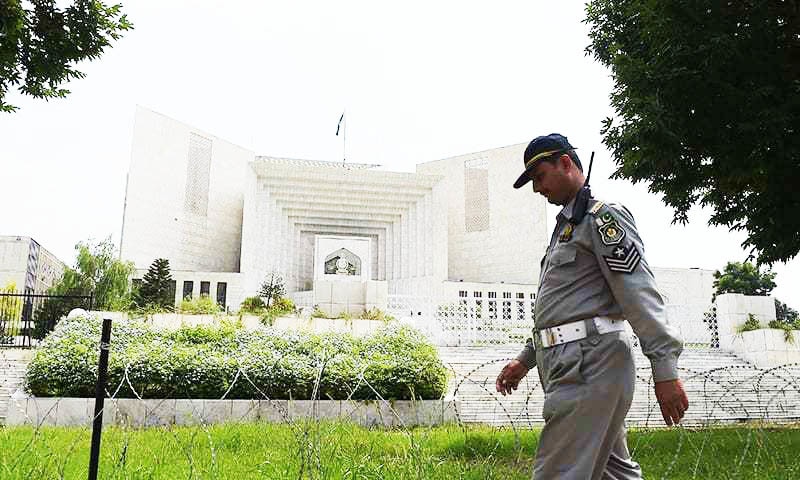


ISLAMABAD: The Supreme Court on Tuesday asked a convict – who had been sentenced to death by a military court – to avail himself of the right of appeal by first approaching the high court under the Pakistan Army Act, 1952, instead of coming directly to the apex court.
A three-judge bench headed by Justice Ejaz Afzal Khan directed senior counsel Dr Khalid Ranjha, representing Lahila Bibi – the mother of death row convict Sabir Shah – to challenge his conviction by moving an appeal before the military court and then the relevant high court.
Take a look: Military court verdict challenged in high court
However, the court postponed further proceedings for the first week of October, with directions to the counsel to assist the court on the maintainability of the petition.
Believed to be a member of a proscribed organisation, Sabir Shah was convicted for his alleged involvement in the sectarian killing of Lahore-based lawyer Syed Arshad Ali, while he was on his way home, in Aug 2013.
Chief of Army Staff General Raheel Sharif had already confirmed his death sentence last week.
While dismissing petitions challenging the 21st Amendments on Aug 5, a 17-judge full court had, in a majority judgment, reaffirmed that any order passed, decision taken or sentence awarded by the military courts would be subject to judicial review by superior judiciary on the grounds of being coram non judice (carried out in the absence of a judge).
The apex court had also held that the decision to select, refer or transfer the case of any accused for trial under the amended Pakistan Army Act, 1952, would also be subject to judicial review.
With the announcement of the judgment on the 21st Amendment, the Apr 16 stay on the execution of militants, as well as all subsequent executions, had also been lifted.
Soon after the judgment, Zahir Shah – the father of Haider Ali, who also was convicted by a military court – had moved a petition before the Supreme Court on Aug 8 asking the court to order the authorities to provide him the necessary record of proceedings before the trial court so that a proper appeal could be filed.
But the Supreme Court Registrar Office had returned the plea to the petitioner on the grounds that he had not approached the concerned high court.
Referring to Sabir Shah, Dr Ranjha had challenged the death sentence on the grounds that Shah was a juvenile and was not given the right to a fair trial or even informed about the trial by military court.
The counsel argued that Shah’s family members were not even allowed to meet the convict and that he had not been given a chance to engage counsel to plead his case.
Published in Dawn, September 23rd , 2015
On a mobile phone? Get the Dawn Mobile App: Apple Store | Google Play