28
28


SHANGHAI: China on Sunday launched a new, smaller type of rocket from its "Long March" family which will be primarily used for carrying satellites aloft, state media reported, as the country races ahead with an ambitious space programme.
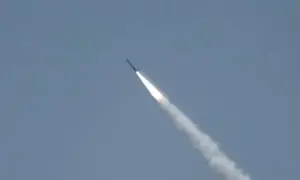
The Long March-6, a newly developed carrier rocket which uses liquid propellant, took off from a launch base in the northern province of Shanxi on Sunday morning carrying 20 "micro" satellites, the official Xinhua news agency said.
The white rocket, imprinted with the Chinese flag at the top, climbed into bluish-grey skies, footage aired by state broadcaster China Central Television (CCTV) showed.
One Chinese official suggested that the smaller rocket will make China more competitive in the lucrative market for commercial satellite launches.
"We believe it will greatly boost the competitiveness of Chinese carrier rockets in the international market," Zhang Weidong, chief designer at the Shanghai Academy of Spaceflight Technology, told Xinhua. "The new model will also significantly improve our ability to access space," he said.
China launches its own satellites as it continues to build a homegrown navigation system, but also carries out launches for other countries and commercial companies.
Environmentally friendly
The rocket is 29.3 metres high, shorter than others actively used in China's space programme, reports said. Long March-6 uses fuel composed of liquid oxygen and kerosene, which is said to be free of toxicity and pollution.
State media hailed the achievement, saying the launch marked a record for the number of satellites carried by a Chinese rocket and its first time for the "environmentally-friendly" fuel.
The small satellites will be used for "experiments" in technology and new products, CCTV said, but gave no details. China's space programme, which has potential military applications, is shrouded in secrecy.
"The separation control for 20 satellites required high accuracy, precision and reliability," Hao Yaofeng, a technician at the Taiyuan Satellite Launch Center, told CCTV.
A 2011 policy paper issued by the State Council, or cabinet, said the Long March-6 would be capable of placing a tonne of payload into orbit at a height of 700 kilometres.
State media publicly announced plans for the Long March-6 in 2009, but said at the time the first launch was scheduled for 2013.
China's "Long March" rocket family is named after an epic journey by Communist forces escaping the then ruling Kuomintang in the 1930s.
Chinese scientists earlier this month said the country is planning to land a lunar probe on the dark side of the moon before 2020, according to state media.
In 2013, China landed a rover dubbed Yutu on the moon, making it only the third nation after the United States and Soviet Union to land on the Earth's natural satellite.
China completed its first return mission to the moon last year with an unmanned probe landing successfully back on Earth.
Also read: India’s positioning satellite aims to serve South Asia