

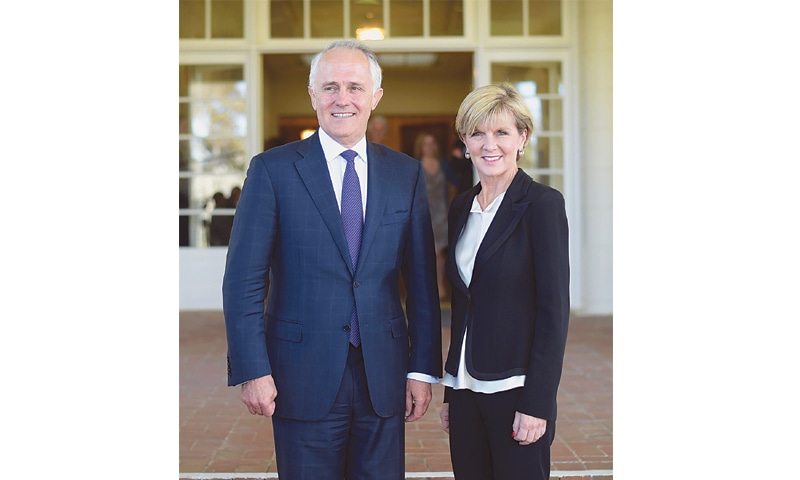
SYDNEY: Australia’s new leader Malcolm Turnbull may have a stellar business record and a way with words, but his skills will be tested to the limit as he tries to revive the economy and energise a government unpopular with jaded voters.
The millionaire former journalist, lawyer and investment banker is renowned for slick salesmanship and has already promised a “new style” of government from ousted premier Tony Abbott, who laboured under repetitive slogans and occasional gaffes.
But the opposition Labor Party is already painting Turnbull as an out-of-touch millionaire who “lives in a pink mansion on Sydney Harbour”, and who might offer a different style — but lacks policy substance.
Analysts say he must quickly address falling government income streams, driven by the loss of tax revenues as a decade-long mining boom unwinds, as well as boost productivity and potentially undertake labour market reforms.
“Prime Minister Turnbull must deal with stagnant economic growth unemployment or under-employment, which will be difficult to shift without a challenging shift in policy direction,” said John Buchanan from Sydney University’s business school.
Australia’s 29th prime minister is not, however, expected to introduce dramatic changes before the next election — likely next year — despite a clamour from some business leaders for real reform.
Rather he will look to fine-tune and better explain existing policies, said Stewart Jackson, a University of Sydney political analyst.
“The big issue at the end of the day is still budget deficit,” Jackson said, adding that Turnbull’s time in banking would be brought to bear.
Turnbull has a wealth of experience in business, having co-founded technology companies including OzEmail in the mid-1990s and starting his own investment banking company before becoming co-chair and managing director of Goldman Sachs Australia.
Despite not having announced any policy changes thus far, business hopes have surged with the change in leader to the tech-savvy and entrepreneurial Turnbull, who was previously communications minister.
“Incoming Prime Minister Malcolm Turnbull has placed some weight on the need to address long-term economic challenges in his public statements, although it remains to be seen whether this will lead to concrete policy changes,” said ratings agency Fitch in a note.
“Is he able to have the courage to say to the Australian people we do need reform?” asked Haydon Manning, associate professor in politics at Flinders University in South Australia.
Voter trust
If Turnbull can succeed in articulating his economic vision to voters and “bring the people with him”, he should be able to win the election expected next year, said Manning.
But the most important thing for the Turnbull government is “that people trust that they know what they [the government] are doing”, Manning said.
Voters have watched leaders come and go at an alarming rate. Turnbull is the fifth national leader since 2010 when Labor’s Julia Gillard ousted Kevin Rudd in a party room coup.
Rudd then did the same to Gillard in 2013 before going on to lose that year’s election to Abbott.
Turnbull’s solid 54 to 44 defeat of Abbott in the Liberal Party room vote should generate less animosity and puzzlement than the sudden overnight knifing of Rudd in 2010, said Manning.
Since January this year when avowed monarchist Abbott announced that Britain’s Prince Philip would receive an Australian knighthood, voters have questioned his judgement.
“Knight the Queen’s husband? For heaven’s sake, he lost it then,” Manning said.
Analysts said Turnbull’s high profile, his good standing in opinion polls and the perception that he holds more moderate views will work in his favour.
Turnbull, who is expected to reshuffle his ministers with the effective Social Services Minister Scott Morrison widely touted to replace Joe Hockey as treasurer, sees a more consultative style of government as key.
“My firm belief is that to be a successful leader in 2015 — perhaps at any time — you have to be able to bring people with you by respecting their intelligence in the manner you explain things,” said Turnbull.
But Nick Economou from Melbourne’s Monash University said while the silver-tongued former barrister has strong support from inner city voters and the political elite, he may struggle to win over the broader electorate.
“The inner cities don’t elect government, the outer suburbs do and the regional cities do, and I think he has got a problem with them,” he said.—AFP
Published in Dawn, September 17th, 2015
On a mobile phone? Get the Dawn Mobile App: Apple Store | Google Play




























