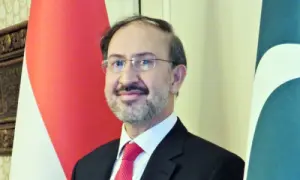
ISLAMABAD: Adviser to the Prime Minister on Foreign Affairs and National Security Sartaj Aziz said on Sunday that the current Indian government under Narendra Modi acts as if it is a regional superpower.
“Modi’s India acts as if they are a regional superpower, we are a nuclear-armed country and we know how to defend ourselves,” said Aziz.
“We also have evidence of Indian agency RAW's involvement in fuelling terrorism in Pakistan,” added Aziz.
Read: NSAs’ talks cancelled over Indian conditions
He also said that while Pakistan has evidence of Indian involvement in terrorism, India on the other hand only has propaganda against Pakistan.
“Propaganda against Pakistan is more important for the Indians, rather than giving us evidence,” stated the adviser to the premier.
Sartaj Aziz also said that India wants normalisation on their own terms, they would like to talk about trade and connectivity but not much else.
He remarked, “If Kashmir is not an issue for India, why have stationed 700,000 troops in Indian-occupied Kashmir?”
The adviser to the premier also stated that India should hold a referendum in occupied Kashmir, and the people would decide their own fate.
"India should realise after the current episode that their tactics are not working, and they need to be sincere about dialogue with Pakistan," added Aziz.
Yesterday, the government decided to cancel the planned meeting of national security advisers with India, citing New Delhi’s refusal to allow an expanded agenda and a meeting with Kashmiri leaders.
The Indian external affairs ministry immediately termed the decision “unfortunate” and tried to wash its hands of the controversy that led to the cancellation of the meeting by saying that it “did not set any preconditions”.
The decision was announced after Indian External Affairs Minister Sushma Swaraj virtually set a deadline for Pakistan to decide by midnight if it was ready to go ahead with the talks by agreeing not to meet the Kashmiri leaders and restricting the discussion to terrorism.
Also read: Indo-Pak security adviser level talks in jeopardy
Besides a discussion on terrorism, Pakistan had sought inclusion of two additional points in the agenda -- a review of the progress on decisions taken in Ufa regarding release of fishermen, facilitating religious tourism and restoring peace along the Line of Control and the Working Boundary; and exploration of the modalities for discussions on other outstanding issues, including Kashmir, Sir Creek and Siachen.
The meeting between the two countries' security advisers was supposed to signal the resumption of talks between India and Pakistan.
Since the meeting between the two premiers in July, militant attacks and border skirmishes have poisoned the atmosphere between Islamabad and New Delhi.