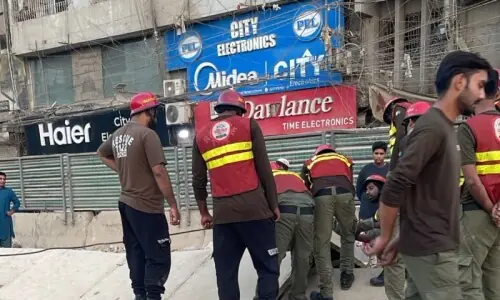
KARACHI: As the horrific attack on members of the Shia Ismaili community in Safoora Goth on Wednesday added another black date to the ever-growing calendar of tragedies in the country, it also put a question mark over the Rangers-led targeted operations across the city.
Irrespective of who carried out the attack or who was behind it, the fact remains that gunmen boarded a bus and killed its passengers on sectarian grounds without being caught. They apparently were not deterred by the so-called Karachi operation launched in September 2013 to rid the city of its law and order menace once and for all.
If one examines the overall methodology of the Karachi operation, particularly in recent months, it appears that judicial procedure — howsoever questionable and patchy — is for those criminals associated with political parties, and ‘encounters’ — whose genuineness is always a moot point — is mostly the fate of suspected militants linked with banned organisations.
Such a policy makes it difficult to make a reasonable assessment of the reach of armed organisations in the country’s financial capital, since the background of militants linked to banned militant organisations and gunned down in ‘encounters’ and information about their prime targets never come to light.
Zohra Yusuf of the Human Rights Commission of Pakistan (HRCP) agrees with this impression.
“There should be no double standards,” she says. “There have been some operations against extremist elements in Karachi by law enforcement agencies, but in no way can it be said that it’s being done to rid the city of them [militants]. I think the policy needs clarity.”
Formation of joint interrogation teams, frequent arrests of suspects on leads found after interrogation of their aides and targeted raids to arrest more criminals are measures that are quite often witnessed in the city. However, it seems that banned outfits and their alleged militants are handled only with ‘encounters’ by law enforcement agencies.
The police record also reflects the trend. The recently released figures of the Karachi police show that during four months — from January to April 2015 — 584 ‘encounters’ left 234 suspects “including terrorists, abductors and dacoits” shot dead. Despite such a high figure of ‘encounters’, city peace remains as elusive as ever.
“I think there should be a comprehensive strategy with clarity. The attitude is not clear. Such incidents point to failure of the entire National Action Plan,” says Ms Yusuf of the HRCP.
Published in Dawn, May 14th, 2015
On a mobile phone? Get the Dawn Mobile App: Apple Store | Google Play