0
0

SURPRISE, surprise: there was a time when even bankers weren’t a complacent lot when it came to (their) money matters. It is not a remark made in a lighter vein. It’s true. Half a century back not just the student community or political groups with unheard voices agitated at the drop of a hat, but the staff of the National Bank of Pakistan also made its presence felt by showing its dissent to their high-ups for not treating them well.
On March 11, 1965 the news item, in which the NBP announced that it had raked a profit of Rs30 million in the year ending December 1964 and would pay Rs2.1 million as dividend, caught many an eye. But the announcement was totally eclipsed by the report which was published the following day, March 12. The headline was quite catchy: ‘Pen-down strike by National Bank staff’. Usually the very mention of a strike in newspaper headlines carries the inherent meaning that work was halted at the workplace where a strike was being observed. Here, however, the ‘manner’ in which work was arbitrarily stopped by members of staff was highlighted: pen-down. Sweet-sounding compound phrase, isn’t it?
Why, you might ask. Well, the strike was observed on March 11 by workers in various branches of the NBP in Karachi to press their demand for an increase in the bonuses that they got in those days. Work was suspended for an hour in the morning. By the way, it wasn’t their first act of protest. On March 10, they had walked out of their offices for a brief period as well. These days, it seems, the National Bank staff is quite content with what they get. Not sure about their customers, though.
Keeping with the theme of strikes, in the second week of March workers of the Telegraph Office too were remonstrating. In fact, their protest had stretched for a longer period than expected and was to continue until the reinstatement of their 600 dismissed colleagues.
Despite all this, and as has been said previously in this column, literary activities were/are never put on hold in Karachi.
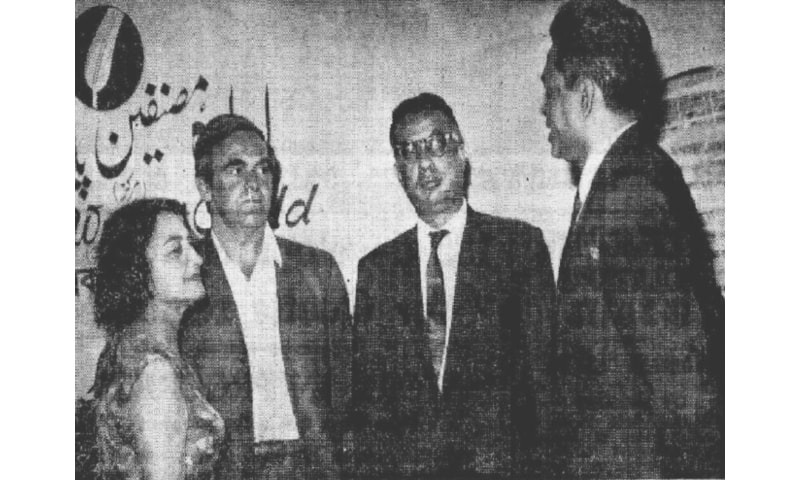
Renowned Russian novelist and short story writer Daniil Granin visited the city for a short period on his way to the Soviet Union from Australia. Addressing his admirers at the Pakistan Writers Guild office on March 12, he stressed the need for translating works of Pakistani and Russian authors and termed it a ‘must’ for bringing the people of the two countries closer. Daniil has reportedly continued to write in the post-Soviet era and his last novel, The Bison, in the late 1980s was a much talked-about book.
Perhaps the most highlighted report (in the media, that is) of that week was the arrival of a German vessel on March 14. Meteor II, claimed to be the largest and most modern oceanographic research vessel of West Germany, came to Karachi at 9.30am and was berthed at No2 West Wharf. It had a crew of 53 people, including 25 scientists, who were supposed to discuss Pakistan’s problems in the field of marine fishery and oceanography during their four-day stay.
PS: It is not right to end a look-back piece on a sad note, but sometimes going with your train of thought you just can’t help it.
On March 9, news which broke a couple of weeks late, saddened all Pakistanis, especially Karachiites. There was a 27-year-old radio engineer (let’s not name the good soul) who worked for PIA Corporation. He landed in London on Feb 27, 1965 on a four-month training course. On March 3, after finishing his duty, he got out of his office and had barely walked a few yards when he was hit by a car. He was rushed to hospital for treatment but died from the injuries. His body was expected to reach Karachi on March 10.
Published in Dawn, March 9th, 2015
On a mobile phone? Get the Dawn Mobile App: Apple Store | Google Play