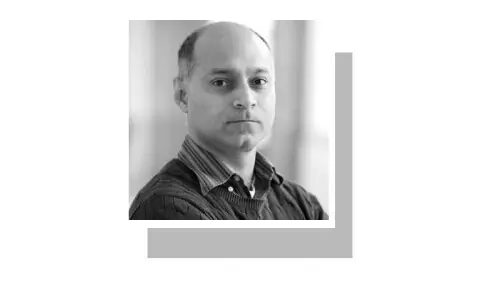
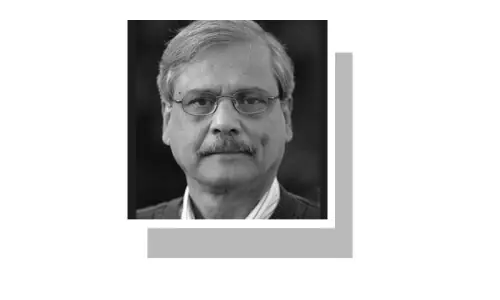
Rasheed Araeen (1935) is a pioneer of modernist art. A contemporary of Sadequain and Hanif Ramay, Araeen moved to London in 1964 to further his artistic practice, and is credited in Britain for his avant-garde Minimalist sculptures from the ’60s. These latticed three-dimensional grids translated his engineering education into artistic design. However, his desire for social engagement led him to introduce public participation into his minimalist practice through a series of works called “Structures”. His geometric modular forms were left in gallery and public spaces for viewers to rearrange and reconfigure. The rigid geometry of his sculptures transformed into perpetual flux, becoming willfully unstable, open-ended and interactive.
 |
| Rang Baranga (1969) |
Araeen was amongst the first Pakistani artists to integrate a radical political consciousness in his modernist practice. By the end of the ’60s, Araeen found the language of minimalism limiting. Daily and scarring encounters with racism in Britain prompted him to engage with a more radical politics. He joined the Artists for Democracy (AFD), which brought him into contact with many other black and Caribbean-born immigrant artists. Together they raised a voice against issues of immigration and racism in Britain, and combined their strengths to resist state violence and marginalisation.
In 1977, Araeen performed ‘Paki bastard (Portrait of the artist as a black person)’ for the first time. His performance marked a break with the medium of sculpture, bringing the body and lived experience to the centre of his work. In this one-man performance, Araeen played the part of an immigrant worker, sweeping the floor, who then becomes a victim of street violence, blindfolded and gagged, whose tragic murder then goes unnoticed and ignored. ‘Paki bastard’ spoke to the painful experiences of immigrants and their vulnerable existences in a limbo-land of fear and violence.
Almost four decades later, Araeen’s radical practice is still as relevant to today’s world. Globally and within Pakistan, there still exists extreme discrimination, injustice and violence against migrants and refugees. The artist’s practice provides an important historical example to the younger generations about the possibilities for meaningful political action through art. In his words, “It is not a question of political art, but an art which embraces the radical consciousness of its time.”
Published in Dawn, Sunday Magazine, February 8th, 2015
On a mobile phone? Get the Dawn Mobile App: Apple Store | Google Play