37
37


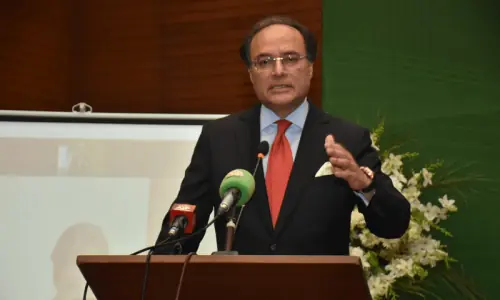
LAHORE: Acting Governor of State Bank of Pakistan (SBP) Saeed Ahmad says that anti-state elements are involved in circulating counterfeit Pakistani currency in the country to undermine the national economy.
“The central bank is vigilant to foil designs of these elements,” Mr Ahmad told newsmen at a conference on ‘currency management: strategies for the future,’ arranged by SBP at a hotel here on Tuesday.
Take a look: Detect a fake note
He said an extensive campaign would be launched to create awareness among the masses about spoiled and counterfeit notes. A documentary had been produced which would be broadcast on TV channels while a smart-phone application had been developed to help people differentiate between the genuine and fake currency, the acting governor said.
The Chairman and Managing Director of Pakistan Security Printing Corporation, Mr Misbah Tunio, said that ‘enemy countries’ were producing Pakistan’s counterfeit currency which was exclusively being used for terrorist activities in the country.
“These counterfeit notes of high quality are used to create law and order situation in Pakistan,” he said, adding that the same paper and ink was being used in producing fake currency but with different serial numbers which only experts could detect.
The acting governor of the SBP said that many security features in the Pakistani currency could help differentiate between a genuine and fake currency notes. “These features are very hard to replicate in the fake note.
However, the people at large usually do not know about these features and the awareness campaign will help them in spotting a genuine currency note,” he said.
The SBP, said Mr Ahmad, was working on introducing hologram and other security features on currency notes. It is a costly plan and it is yet to be decided to which denomination it will be added. Initially, Rs5000 domination notes should have hologram that should be followed by Rs1000 notes while the rest would be considered at a later stage,” he said.
To a question, Mr Ahmad said that the government’s domestic borrowing declined due to increase in remittance, IMF loans and sale of Euro Bond and Sukuk.
“The government has decreased its borrowing cost by shifting reliance from local to foreign borrowings. The government has been criticised for floating both the bond and Sukuk on high rates, but in reality they have managed to save money because the rate in the local market ranges between 10 to 12 per cent while both the EU bond and Sukuk were offered at 7 per cent in the international market,” said Mr Ahmad.
Published in Dawn, February 4th, 2015
On a mobile phone? Get the Dawn Mobile App: Apple Store | Google Play