41
41


IN the fight against militancy, the military has and will have an important role to play given that counter-insurgencies still need to be conducted across swathes of territory in Fata and the movement of militants across the Pak-Afghan border in both direction needs to be curbed.
Beyond that, however, an expansive role for the military would represent a renewed militarisation of security policy that will have far-reaching, hard-to-reverse consequences. Consider the call by Interior Minister Nisar Ali Khan yesterday for Balochistan, Khyber Pakhtunkhwa and Sindh to not only keep army personnel already deployed in those provinces on security duties but to extend the cover of Article 245 to army operations inside those provinces.
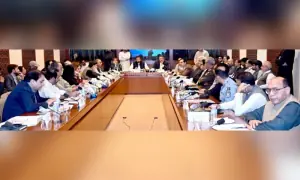
Also read: Political leaders reach consensus on military courts
It is striking that while the interior minister flatly claimed that the police forces of the country were not trained or equipped to deal with counterterrorism problems, his request to the provinces outside Punjab indicated a belief that somehow the military is trained and equipped to deal with counterterrorism operations.
But is that necessarily the case? While the military has introduced training for counter-insurgency environments, has it really both the resources and the training to deal with terrorist networks in urban environments? No one appears to have thought to ask that question.
Far too often, when the civilian side of the state is known or believed to not have the required capacity to deal with a particular problem, the military is automatically assumed to already possess those capabilities.
Sometimes that leads to truly alarming decisions, such as the one taken by parliamentary leaders yesterday that military courts be instituted across the country to try terror suspects. While the country is facing an unprecedented threat, is the impulse to draw the military further into the fabric of urban, and even rural, administration a remotely good idea?
Military courts have different standards of proof, offer fewer protections to the accused and when its relatively abrupt systems are applied to a civilian environment can lead to gross miscarriages of justice.
The country has already seen in the case of missing persons that simply because the military believes someone to be a militant or terrorist, the individual is not necessarily proved to be one.
Does it make sense to bypass altogether a well-developed, civilian-led judicial system simply because that system’s implementation may be flawed?
Would it not be far better to urgently consult the judicial and legal community and draw up a list of measures that can be taken to make way for a more responsive criminal justice system that ensures terrorists are convicted without sacrificing the principles of a civilian-led democratic polity, no matter if that polity is dealing with a fundamental threat to its existence?
In such matters, doing the right thing is often harder than simply bowing to the logic of expediency. But the country should not give up its democratic core to fight the enemy.
Published in Dawn, December 25th, 2014