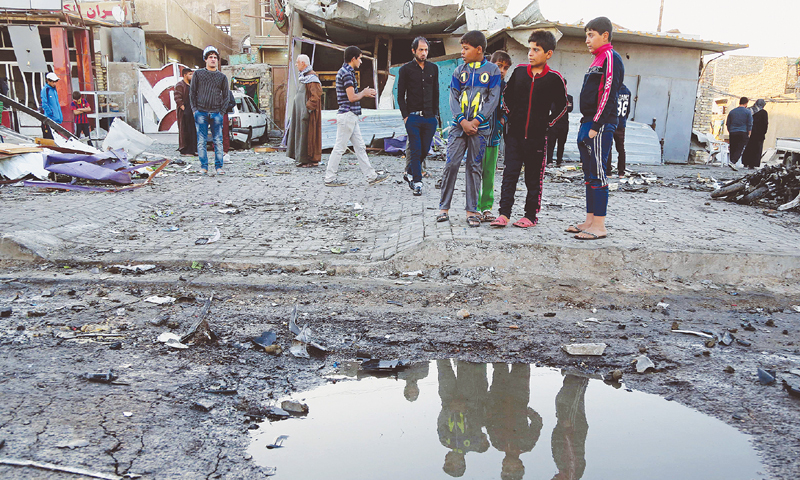
BAGHDAD: Iraqi military forces reached the centre of the northern city of Baiji on Sunday in an effort to break an Islamic State siege of the country’s biggest refinery, triggering fierce clashes with the militants, according to an army colonel and a witness.
Islamic State insurgents seized Baiji in June during a lightning advance through northern Iraq. Since then, they have surrounded the refinery and halted its production while a detachment of government troops has held out for months under siege inside it.
The colonel said Iraqi troops entered Baiji, a city of about 200,000 people, from the south and west and took over the al-Tamim neighbourhood and city centre.
Islamic State had placed bombs along roads in Baiji and deployed snipers to keep government forces from advancing, tactics used in other cities held by the ultra-hardline group, which controls swathes of both Iraq and Syria.
“There are IEDs (improvised explosive devices) and snipers that are slowing down the advance, but the presence of the air force has facilitated the process of dismantling the IEDs in order to push forward,” said the colonel.
“The areas taken so far are 6 km away from Baiji’s refinery,” he added. He said 12 militants had been killed.
Baiji resident Sultan al-Janabi said that clashes had been raging since the advance, the first time security forces reached the city centre since launching a new encirclement strategy at the end of last month.
“Violent confrontations are taking place in Baiji right now. I’ve been hearing continuous fire and loud bangs,” said Janabi.
US air strikes destroyed an Islamic State convoy near the Iraqi city of Mosul on Friday evening but US officials said on Saturday it was unclear whether the group’s top commander Abu Bakr al-Baghdadi had been in any of the 10 targeted vehicles.
One Twitter account claimed Baghdadi had been wounded but others that support IS said the report was untrue.
There has been no official confirmation from the United States military or Iraq that Baghdadi was wounded.
Islamic State has also dispatched suicide bombers to keep security forces on the defensive.
POLICE GENERAL KILLED: On Friday night, a suicide bomber rammed a truck packed with explosives into a Humvee transporting senior police commander General Faisal Malik, one of the supervisors of the campaign against IS militants surrounding the refinery. The general and two policemen were killed.
The truck used in the attack was armoured, the army colonel and a provincial police command centre said, suggesting Islamic State had seized it from defeated Iraqi troops. Tanks and anti-aircraft weapons have also been taken.
The army colonel estimated that Iraqi forces had taken about 40 per cent of the city centre. That could not be independently confirmed.
Iraqi security forces have used helicopters to attack Islamic State insurgents surrounding the refinery.
But months of operations have failed to rescue comrades trapped inside and ensure the strategic site will not fall into the hands of IS, who have used oil and fuel to fund their self-proclaimed caliphate.
Iraqi oil industry officials estimate Islamic State is making multi-million dollar profits from the illegal trade.
Government forces, including counter-terrorism units, inside the compound have been surviving on airdrops as military forces outside tried to drive IS militants away.
The Baiji refinery was producing around 175,000 barrels per day before it was closed, a senior Iraqi official said in June. Iraq’s domestic daily consumption is estimated at 600,000-700,000 bpd.
If the siege of the Baiji refinery is broken, Iraq’s government is likely to describe it as a major victory over IS. Iraqi media portrayed the slain general, Malik, as a hero.
The country’s long-term stability hinges on efforts to dramatically improve the performance of the army, which crumbled when Islamic State swept through the north.
Published in Dawn, November 10th, 2014