BERLIN: For all Angela Merkel’s headline-grabbing “green revolution”, Germany’s image as a world leader on environmental policies is in danger of falling under the shadow of the smoke stack and a cloud of exhaust fumes.
Increasing dependence on brown coal has raised doubts about whether Berlin will hit its medium-term CO2 emission goals. And though EU regulations have helped bring down vehicle emissions, critics denounce the political reluctance to confront Germans’ passion for big, fast cars.
Having led the pack on emission reductions thanks in part to a rapid expansion in power generation from the sun, wind and other green sources, Germany is now slipping behind, with CO2 emissions rising for the second straight year in 2013 in Europe’s biggest economy.
Just seven years ago the media dubbed Merkel “climate chancellor” for convincing Group of Eight leaders, including then US President George W. Bush, to consider cutting greenhouse gas emissions by 50 per cent by 2050.
Ambitious then, it looks even more so now, especially as the Ukraine crisis pushes energy security up the agenda.
“In 2007, it was a bit simplistic. People thought it would be an easy ride,” said Christian Egenhofer, head of the energy unit at the Brussels-based Centre for European Policy Studies.
“The (green) philosophy holds, but domestically things have become more difficult and more cautious,” he said, adding global constraints, such as a lack of a comprehensive deal at the 2009 Copenhagen climate conference, had made things more difficult.
After failure in Copenhagen, almost 200 nations are aiming to agree a UN deal to fight climate change at a summit in Paris in late 2015. With many nations still focused on reviving economic growth, achieving a binding treaty is expected to prove elusive.
The “Energiewende”, or switch to renewable energy away from nuclear and fossil fuels, is the centrepiece of Merkel’s energy and environment policy. It is a bold experiment for Europe’s industrial powerhouse that other countries might follow — if successful.
Since 2000, when green energy incentives were introduced by a Social Democrat and Greens coalition, Germany’s renewables sector has boomed. It accounted for 23.4pc of power generated in Germany in 2013, up from 6.2pc in 2000.
Merkel made the policy her own after the 2011 meltdown at Japan’s Fukushima reactor by speeding up the nuclear phase out. But she has drawn criticism for shielding industry from bearing more of the cost of the subsidies for green energy, which have pushed up retail power prices.
Coal vs goal
Much concern is focused on Germany’s reliance on brown coal, which harms the environment more than other types of coal, for a secure and affordable power supply. Last year lignite was the single biggest source of German power, generating 25.8pc, and it has risen every year since 2010.
Greenpeace says no other country in the world extracts and converts as much brown coal into electricity as Germany.
“Germany is making itself a laughing stock because it hasn’t set limits on brown coal,” said Greenpeace’s Karsten Smid, who wants the government to say when it will phase it out.
Coal-fired power plants, responsible for about a third of Germany’s CO2 emissions, are also hitting climate change goals.
“Failure to reduce the persistently high level of coal-fired power generation threatens Germany’s climate targets .. and undermines a sustainable energy transition,” said a report co-authored by energy economist Claudia Kemfert at Berlin’s DIW.
The environment ministry has already warned Germany may miss its goal to cut greenhouse gas emissions by 40pc by 2020 from 1990 unless it steps up its efforts. Having achieved a 25pc fall by 2012, it is now on track to miss the target by seven percentage points.
Germany’s goals may be more ambitious than the EU’s 20pc aim, but rapid cuts in the early years were achieved relatively easily by overhauling Communist-era factories in eastern Germany. Last year, Germany emitted 951 million tonnes of greenhouse gases, up 1.2pc from 2012.
Merkel has shown leadership in some areas, such as promising $1 billion — far more than any other donor so far — to a Green Climate Fund to help developing nations tackle global warming, but media have widely accused her of neglecting the issue.
Pressed last week, she vowed to focus on it next year in Germany’s G7 presidency but gave no clues on policies, such as boosting gas usage.
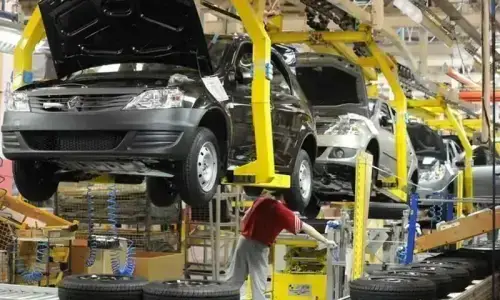
Germany’s mighty car sector is another problem, say critics.
Though smaller cars are growing popular elsewhere, especially in the key export market of China, they aren’t catching on in Germany.
According to an International Council on Clean Transportation (ICCT) report, Germany has seen the second-biggest increase in passenger car mass in the EU over the last decade after Sweden, and German drivers take to the wheel with 13.4pc more power in their pedal than the average European.
Published in Dawn, September 5th, 2014