1
1


ISLAMABAD: The political leaders attending a national security conference here on Saturday endorsed Operation Zarb-i-Azb and underscored the need for bringing to logical conclusion efforts to eliminate the terrorist infrastructure in the tribal areas.
They asked the government and the military to address extremism and work out a long-term strategy for eliminating militancy and terrorism.
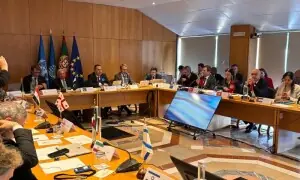
The conference, convened by the government for a briefing on Zarb-i-Azb, was attended by the leaders of parties represented in the National Assembly and military commanders.
This was the second conference on militancy in 12 months – the previous one held on Sept 9 last year had authorised the government to hold dialogue with the outlawed Tehreek-i-Taliban Pakistan.
“There was absolute unanimity of views on the need to evolve a strategy to eliminate terrorism on a long-term basis. The meeting also agreed to work to address extremism,” a statement said.
A senior parliamentarian, who attended the conference, said he witnessed “rare consensus” among the political leaders against extremism and terrorism, some of whom even called for action against sectarianism.
The media statement on the conference also noted “the rejection of terrorists and their ideology” by the political parties and the nation as a whole.
The parties stressed upon the government to ensure effective border management to prevent the terrorists from returning to the region.
In this regard, the government was asked to engage Afghanistan politically and diplomatically for removing lingering distrust.
Prime Minister Nawaz Sharif, while speaking at the conference, recalled the circumstances that led to the launch of the military operation after his dialogue initiative failed.
Terrorism, he said, had resulted in massive casualties among civilians and security personnel, besides causing huge loss to the national economy.
Endorsing the military operation in North Waziristan, “representatives of all political and religious parties agreed that the state has to fight and eliminate militancy”.
The participants were told that the military operation and contingency planning for pre-empting the feared blowback had been given the required legal and constitutional cover through the invocation of Article 245.
The parliamentary leaders were given a briefing by the director general of military operations on the progress in the operation and handling of the displaced people.
The conference was told that terrorists were on the run and their command and control system had been crippled.
Efforts were also being made to block financing of terrorism, the participants were informed.
Published in Dawn, August 10th, 2014