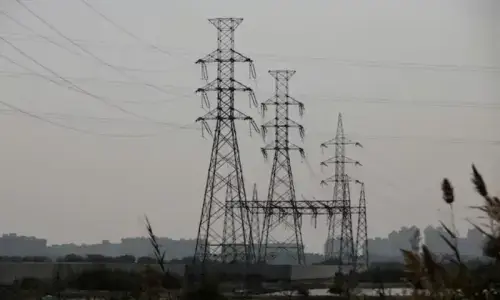
ISLAMABAD: The National Electric Power Regulatory Authority (Nepra) has revealed that the management of K-Electric, including a former managing director and all its regional heads, have been involved in over-billing its consumers and issuing unjustified and inflated bills to maximise revenue.
In a unanimous decision taken by a three-member Nepra body, the current K-Electric managing director has been asked to take action against the officers involved in excessive billing, including its former chief executive Tabish Gohar, as well as ensuring that no such incident take place in future. The regulator has sought a report on implementation of its orders and actions against the accused within three weeks.
The regulator said it had separately initiated proceedings against K-Electric under Nepra (Fines) Rules, 2002, but the power company had filed a civil suit in the Sindh High Court, challenging the Nepra notice.
Inquiry reveals top officials knowingly violated rules to maximise revenue
The Nepra investigation spanned 18 months of inquiries and hearings into six separate complaints, including some referred to it by the Supreme Court. Nepra obtained certain emails from K-Electric officials, ordering additional billing of consumers. One of the company’s former general managers, Shoaib Siddiqui, confessed that he “issued directions to field formations to carry out excessive billing and issue detection bills”.
Detection bills are issued when a consumer’s meter cannot be read properly or has malfunctioned. An estimated bill is generated in such cases.
Mr Siddiqui resigned after the inquiry but was given a job in Byco – a sister organisation of K-Electric. He “was made a scapegoat to protect the KESC management and was accommodated in an Abraaj group concern. Another executive, Arshad Iftikhar, Mr Siddiqui’s supervisor, was issued a warning and later on, promoted,” the inquiry held.
Some of the complainants referred to orders for 10 million units of excessive billing in September 2012, but Mr Siddiqui confirmed that two million units were billed through 11 cycle days. Nepra said the over-billing that was supposed to be carried out did not actually take place because certain emails were leaked and exposed in the print media.
It said the orders for extra billing of 11 cycle days, an increase of 50 units for all consumers and the issuance of unjustified detection bills were issued by the former KESC chief executive officer on September 18, 2012.
Nepra said K-Electric did hold an inquiry into the matter once the emails became public, but tried to cover up the issue. It said K-Electric did not record some emails that were provided to it during inquiry “which is sufficient to prove the involvement of senior management”.
The regulator said that on inquiry by Nepra, the KESC concealed the facts and reported that the top management was not involved in issuing these directions. The record, however, suggests that it was clear that the power company’s management was involved. “Concealing the facts from Nepra constitutes violation of the provisions of section 44 of the (Nepra) Act, Rule 20 of Nepra Licensing (Distribution) Rules 1999 and Article 15 of KESC’s distribution licence”.
It said that from the emails it was clear that the KESC has been issuing such directions to field formations on a regular basis. It was also clear that these bills were being issued without observing the code laid down in the consumer service manual.
Published in Dawn, June 20th, 2014