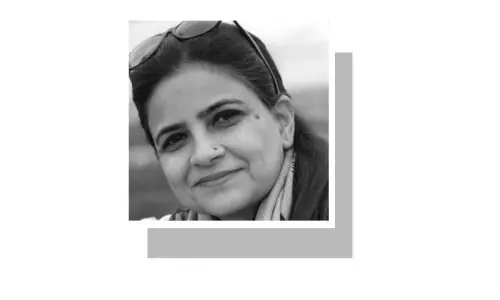
Among Pakistan’s most acclaimed artists, Karachi-based Meher Afroz shares how we, as a nation and as a society, have lost touch with ourselves, with mankind, our history and nature in her solo show ‘Behisht-i-Gumshuda’ at Islamabad’s Khaas Art Gallery.
Born in Lucknow, India, Afroz has been an artist and an art educator since the ’70s. Her imagination in the 16 displayed pieces allows viewers to be transported into a world of blue, silver and black, integral colour schemes in this body of work. Behisht-i-Gumshuda means the lost paradise whereby she interprets human psyche, emotions and values within society.
 |
| Another exhibit. Photos by the writer |
Her painting technique of overlapping surfaces, layer over layer of paint, accentuated by developing the process through Islamic symbols and verses from the Holy Quran, creates an emotive subtlety on her surfaces. The dynamically worked textures in graphite, acrylic and silver leaf on the canvases refine her work through the exploration of the artist’s unique texture building style. The paintings have a language of their own by creating a pictorial narrative between the artist and the viewer.
There is no figurative element evident in this collection, rather the surfaces are representations of the classic components of the Islamic art. Geometric patterns made up of regular lines and repeated shapes, which can be reflected or rotated to create a pattern of squares and triangles, are fundamental in the present work. Perhaps the repetitive square patterns, which eventually transform into triangles refers to a systematic order, leading to the path of truth and the constant use of silver leaf indicates untaintedness.
The text reinforces a constant zikr, a celebration of the Divine, a mainstay of Sufi practice, for example, in the repetition of pertinent word Hu from Allah Hu, which is a traditional Sufi chant. The Hamsa or Hand of Fatima is also an interrupted part of Afroz’s current work and is a depiction of loyalty, faith and resistance against difficulties. All these components that are the building blocks of her canvases are a reminder of how man has strayed and become directionless.
The foundation of Afroz’s art of devotion is a constant questioning and reasoning of mankind and its evil practices. She creates a distance from the world that places her on this spiritual path, on a quest for celestial purity and coherence with the Divine.
Artichive: The Realist School
 |
The Realist School, an art movement of the mid-19th century was formed as a reaction against the severely academic production of the French school. Realist painters sought to portray what they saw without idealising it, choosing their subjects from the commonplace sights of everyday life.
Gustave Courbet was the first artist to proclaim and practise the realist aesthetic; his ‘Burial at Ornans’ and ‘The stone breakers’ (1849) shocked the public and critics with frank depictions of peasants and labourers. In his satirical caricatures, Honoré Daumier used an energetic linear style and bold detail to criticise the immorality he saw in French society. Realism emerged in the US in the work of Winslow Homer and Thomas Eakins.
In the 20th century, German artists associated with the Neue Sachlichkeit worked in a realist style to express their disillusionment after the World War I. The Depression-era movement known as ‘Social Realism’ adopted a similarly harsh realism to depict the injustices of US society. — S.A.
Published in Dawn, Sunday Magazine, May 18th, 2014