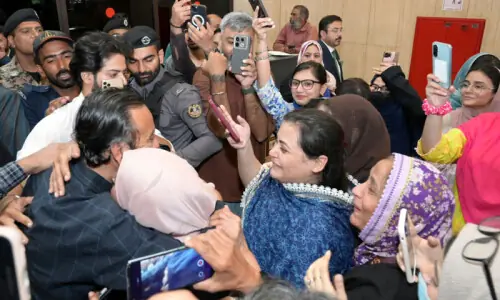
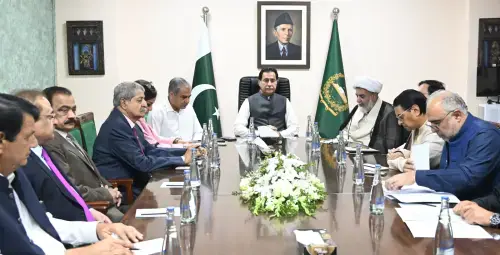
LARKANA: Bilawal Bhutto-Zardari, patron in-chief of PPP, launched on Saturday the project for dry core drilling, a scientific process for determining limits of the ancient Moenjodaro city. Unesco has been demanding the drilling since 2006.
Sharmila Farooqi, adviser to chief minister on culture, told the PPP head in the presence of experts that it was the first ever indigenous effort at Moenjodaro after a similar small scale exercise carried out by George F. Dales, an American archaeologist, about 50 years ago.
Qasim Ali Qasim, director of archaeology department, told Dawn that Dr Dales had carried out the dry core drilling in 1965 in HR area of Moenjodaro at eight pin-pointed locations. The drilling which would cost Rs8.7 million had been initiated near the museum and laboratory at NW-1 location, he said.
It would be carried out in crisscross and diagonal fashion at 40 points, which had already been identified. The drilling would be done at a distance of 100 meters to the depth ranging from 15 to 20 meters, he said.
He said the coring process would take two months and within another two months the drilling would be completed while a month would be required for preparing the report. The object was to establish a buffer zone and the core area for which the UNESCO had been demanding since long, he said.
The analytical study would be carried out at the laboratory of the Centre for Pure and Applied Geology, University of Sindh, while the archaeological aspects of the funding would be supervised by the director of archaeology, said Mr Qasim.
Prof Dr Sarfraz Solangi and Dr Asghar Ali Hakro of the SU centre would continue to supervise and monitor the entire process, said sources in the culture department.
Ms Farooqi said the process of dry core drilling included drilling, coring to 20 metres depth and a detailed study of the core to be carried out at Moenjodaro by experts of archaeology and sedimentology to identify cultural and natural layers of the site.
Based on the core logs, sedimentological laboratory analysis and interpretation of final assessment about the extent of Moenjodaro remains would be carried out, she said.
She said that it was well known that about 100,000 people used to inhibit the city but the existing excavated area did not conform to this notion, said MS Farooqi said. She said it was thus necessary to ascertain the limits of this proto-historic cosmopolitan city to determine its size.
Abdul Razzak Soomro, former ambassador and member of executive board, Dr Saeed Ahmed Mangnejo, commissioner Larkana (member); Syed Hakim Shah Bukhari, Prof Altaf Hussain Mangi, members technical consultative committee on Moenjodaro; Bashir Ahmed Brohi, secretary culture; Qasim Ali Qasim, director archaeology Sindh; Kazi Ayaz Mahesar, representative of UNESCO in Islamabad, and Syed Shakir Ali, director exploration and excavation and member technical consultative committee, attended the launching ceremony.