4
4


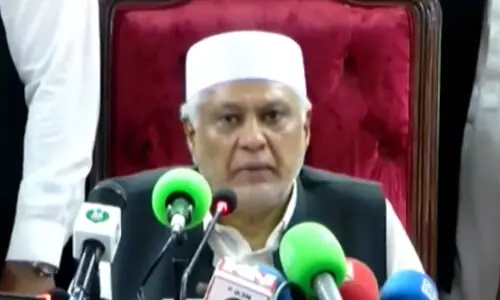
ISLAMABAD: The chairman of Pakistan Ulema Council, Hafiz Mohammad Tahir Ashrafi, has asked the Taliban leadership to identify the renegade groups.
Addressing a press conference at the National Press Club on Wednesday he said the suggestion would help government differentiate between those who want to negotiate and those who didn’t.
“The simple policy should be to talk with those who want to hold talks and go for operation against those who do not want to talk with the government,” Hafiz Ashrafi said.
The PUC chairman also demanded that the government should go for direct talks with Taliban, instead of intermediaries as direct talks would produce fast results.
“It is a good sign that the gruesome Islamabad court incident has not shattered the ceasefire,” he said.
After the ceasefire, Hafiz Ashrafi said, Taliban should show their seriousness to end the conflict.
“I demand that the Taliban leadership should return the bodies of slain FC men,” the added, “while both sides should release each other’s non-combatant prisoners.”
He did not make any comment on the existence of foreign intelligence in Pakistan, but said that there were terrorist training centres in Afghanistan operated by the intelligence units of that country.
“They are mainly responsible for the terror activities being executed inside Pakistan,” he said.
Hafiz Ashrafi, who belongs to Deobandi school of thought, but is mostly at odd with most of the Ulema of his sect because of his liberal and progressive views.
He again called upon the Taliban leadership to reconsider their position over the polio eradication drive.
“If there has been anything wrong with the anti-polio drive, they should make it public rather than opposing the whole campaign,” he said.
“If there are any concerns about the campaign, they (Taliban) should let them be known to the government through media or ulema, and even my services are available in this regard.”
He said that Pakistan needed to have rigorous anti-polio campaign to counter the resurgence of this crippling disease.
“Thirty-two Islamic institutions including those in Saudi Arabia and Al Azar Egypt have validated the anti-polio drives, so considering polio eradication campaigns as un-Islamic is not correct,” the PUC chairman said.