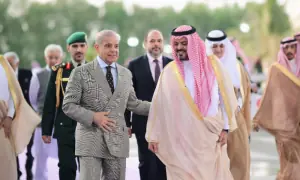
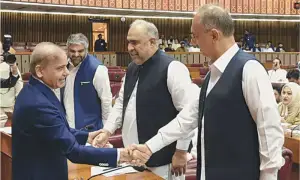
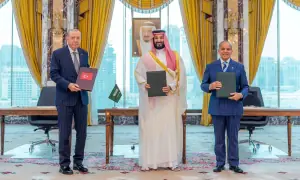
GIVEN the long history of friendly ties between the two countries, the identity of views expressed by Pakistan and Saudi Arabia in Monday’s joint statement at the end of Prince Salman bin Abdel Aziz bin Saud’s visit was to be expected. Besides being host to a large Pakistani expat community, Saudi Arabia has bailed out Pakistan in moments of acute economic crises. The relationship acquired new dimensions with the return to power of the Sharif family as evident from the high-level visits by Saudi royals in recent weeks. However, foreign policy is a different ball game, and Pakistan has to prioritise its national interests instead of getting carried away by emotions. In this respect, certain aspects of the joint statement are somewhat disturbing because they suggest a possible shift in Pakistan’s Syria policy. As always, we believe that in the Syrian conflict, as in other regional flashpoints, Islamabad needs to maintain a certain level of neutrality and perform a fine balancing act so as to avoid distortions that may offend friendly states.
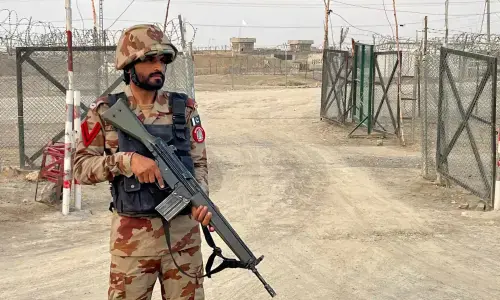
The situation in the Levant is far more complex than what is stated in the joint statement. For instance, the call for a withdrawal of foreign forces should have been a bit more specific, as Syria is now home to a multilateral conflict with several regional states backing militias working at cross-purposes. The anarchy in Iraq has served to aggravate the Syrian crisis because Al Qaeda and other militant groups have moved into the country and changed the very character of the Arab Spring. So far, Pakistan has avoided taking sides in the Syrian charnel house. However, in the joint statement Pakistan seemed to agree with Saudi Arabia that President Bashar al-Assad must go, because it called for “the formation of a transitional government with full executive powers” to take over Syria. Given the failure of the Geneva talks and the hard positions adopted by all sides, it seems well nigh impossible how a plan calling for President Assad’s exit can be agreed upon and put in place through talks. This shows Pakistan is in no position to discard neutrality and be a party to a regional conflict that shows no signs of abating. The joint statement coincided with an Iranian warning that Tehran could send troops into Pakistan to recover kidnapped border guards. The statement should not be taken literally, but it does convey Iran’s unease if not anger over the higher level of Saudi-Pakistan ties with security implications.
It is ironic that, in these difficult times, Pakistan has no foreign minister, and our external relations go lurching from crisis to crisis. Parliament is obviously the forum for discussing foreign policy, and it is appalling that serious matters involving potential changes in external relations should not be debated by our legislators before a policy is formalised.