GENEVA: Syria's regime and opposition on Saturday discussed sending aid to besieged residents in the embattled city of Homs as UN-sponsored peace talks inched forward in Geneva.
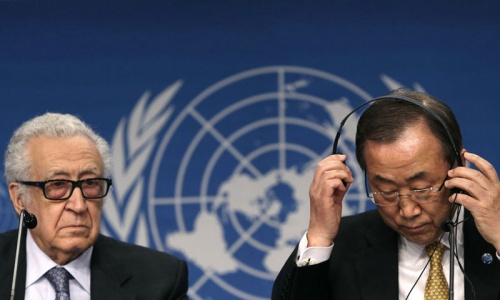
In what mediator Lakhdar Brahimi said was a “good beginning”, the two sides touched on a key humanitarian issue as they held their first face-to-face talks at the United Nations' European headquarters.
Brahimi said they had discussed at length the situation in Homs, where hundreds of families in the Old City are living under siege with near-daily shelling and the barest of supplies.
“We hope that ultimately some convoy of aid, goods, both food and non-food items and some medical supplies will be allowed to go into the Old City” as early as Sunday or Monday, Brahimi said.
He said talks would continue on Sunday and touch an another key issue, trying to free some of the thousands of people being held in Syrian jails or kidnapped.
“We haven't achieved much but we are continuing,” Brahimi said. “If we achieve success on Homs we hope that this will be the beginning.”
Opposition spokesman Louay Safi said a deal on Homs was like a “trial balloon” to test the regime.
“If the regime does not open humanitarian corridors for people who are starving to death, this means that the regime wants a military solution and not a political solution,” he said.
After a false start on the first day of discussions, the two sides agreed to sit in the same room on Saturday, with both delegations addressing Brahimi instead of each other.
Despite the failure to agree on any concrete proposals, Saturday still marked progress after President Bashar al-Assad's regime on Friday accused the opposition of obstructing the negotiations and threatened to walk away.
Pulled together by the United Nations, Russia and the United States, the two sides are meeting in the biggest diplomatic push yet to stem Syria's bloodshed after nearly three years of civil war.
The opposition insists the talks should focus on Assad leaving power and the formation of a transitional government based on an agreement reached during a first peace conference in Geneva in 2012.
The regime says Assad's role is not up for debate at this conference, dubbed Geneva II, and denies that the initial Geneva deal requires him to go.
Safi said the opposition wanted to start discussing the core issues of a political transition on Monday.
“What is happening today and tomorrow is a prelude,” he said. “It's on Monday that the formation of a transitional government will be dealt with.”
Situation in Homs 'dire'
Expectations are very low for a serious breakthrough at the talks, which are expected to last about a week, but diplomats have said simply bringing the two sides together for the first time was an important step.
With no one appearing ready for serious concessions, mediators are focusing on short-term deals to keep the process moving forward, including on localised ceasefires, freer humanitarian access and prisoner exchanges.
The opposition delegation had pressed for Saturday's talks to focus on Homs -- a strategic industrial city between Damascus and northern Syria, parts of which have been under siege since June 2012 after rising against the regime.
Anas Al Abda, a member of the opposition negotiating team, said the opposition wanted to discuss a “one- or two-week ceasefire” and humanitarian access to the city.
He said a deal could move quickly because the International Committee of the Red Cross had already made some approaches in Syria about arranging aid deliveries and exit corridors from the city.
The ICRC refused to confirm this, but its head of operations for the Middle East, Robert Mardini, told AFP it was ready to help if it has guarantees of access and security.
“The challenge is always how to translate this agreement or commitment into very concrete actions on the ground,” he said.
“Our last visit in the Old City of Homs was in November 2012, and it was already besieged at that time and the situation was dire, so you can imagine it has certainly not improved now,” he said.
Erupting after the regime cracked down on protests inspired by the Arab Spring, Syria's civil war has claimed more than 130,000 lives and forced millions from their homes.
Pitting Assad's regime, dominated by the Alawite offshoot of Shia Islam, against largely Sunni Muslim rebels, the war has unsettled large parts of the Middle East.
The fighting continued in Syria on Saturday, with the regime's air force striking rebel-held areas near Damascus and Aleppo, a monitoring group said.
The Syrian Observatory for Human Rights also said fighting was raging across Syria's multiple fronts, including at the besieged Yarmuk Palestinian refugee camp in southern Damascus.