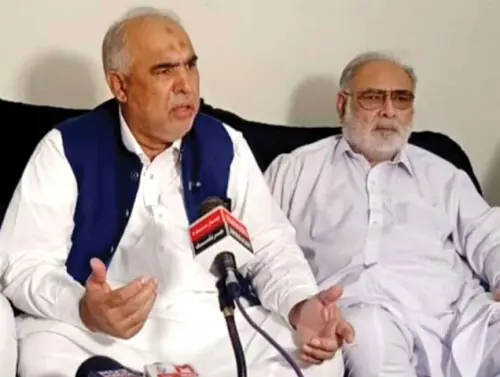
IT is not uncommon for tribal overlords in Balochistan and their wayward progeny to get into trouble with the law. From rival clan killings to brutal murders of allegedly errant wives, they have been blamed for all sorts of crimes of passion over the years. And yet does the recent arrest of the chieftain of the Khetran tribe, MPA Sardar Abdur Rahman Khetran, for torturing policemen indicate that their once unchallenged power is finally on the wane?
In a province ravaged by militant separatism, the answer to the question now lies in the relationship between the chieftain and — not the governments in Islamabad and Quetta — but insurgents in their mountain redoubts.
Bugti, Marri and Mengal tribesmen who first spearheaded the insurgency and then became comrades-in-arms of guerrillas fighting for an independent homeland — and giving paramilitary troops a bloody nose every now and then — do their chieftains proud. In fact, their chieftains — one killed by Pakistan’s armed forces and the other two who are still alive and in their late 80s — have become icons for the struggle of autonomy in resource-rich Balochistan.
“These three chieftains initiated the struggle for autonomy in Balochistan. Their authority has remained undiminished over the years,” says Editor of Balochistan Express, Siddiq Baloch.
“The insurgency in Balochistan is home-grown, with no well-defined command and control structure. It spread from the strongholds of the Bugti and Marri tribes to other areas simply because the army foolishly adopted the ‘kill-and-dump’ policy in Balochistan,” he says referring to the mutilated and bullet-riddled bodies of victims of enforced disappearances that turn up regularly in Balochistan as well as in Karachi.
The Voice of Missing Baloch Persons, a human rights organisation whose members are on the march across Pakistan these days, estimates that 100 Baloch men fell victim to the military establishment’s systematic campaign of ‘kill-and-dump’ in 2013.
Just as anti-establishment chieftains have been revered as role models by autonomy-seeking militants, tribal overlords perceived to be close to Islamabad — or, worse still, the army’s general headquarters in Pindi — have incurred the opprobrium of the local populace that has long felt to have been wronged by other provinces, particularly Punjab.
A bomb attack on the convoy of Sardar Sanaullah Zehri — whose sobriquet of chief of Jhalwan indicates that he is the chief of chieftains in lower Balochistan — in the run-up to the May 2013 elections left his son, brother and nephew dead.
“There were three surprising things about this attack on an extremely influential pro-establishment chieftain. One, he was targeted in his own backyard. Two, the Balochistan Liberation Army accepted responsibility for it. Three, the attack met with the approval of the locals perhaps because they had suffered increasingly on account of criminal activities blamed on the chieftain’s relatives. The BLA attacked him because he had reportedly handed over insurgents to intelligence agencies,” says Quetta-based senior journalist Shahzada Zulfiqar who has written extensively on Balochistan.
“Before the deadly BLA attack, the Balochistan Liberation Front had made an abortive attempt on Sardar Zehri’s life. Similarly, both former governor Nawab Zulfiqar Ali Magsi and chief minister Nawab Aslam Raisani had been targeted in attacks blamed on insurgents. So, clearly the insurgents have emerged as a centre of power over the years.”
Ironically it is the insurgents and not the much-vaunted parliamentary democracy that has been responsible for a gradual curtailment of power wielded by tribal overlords in Balochistan. But despite this, it should not be assumed that age of the chieftains is now over.
Indeed most of the members of the 20-strong cabinet headed by Chief Minister Dr Abdul Malik Baloch of the National Party are either chieftains themselves or are related to powerful tribal families.
“Parliamentary democracy is not enough to curb the power of Sardars,” concedes Senator Hasil Bizenjo, also of the National Party. “This is only possible with socio-economic development, which has been painfully slow to come to Pakistan. Besides, it is wrong to say that insurgents have targeted Sardars. They may have targeted a few Sardars, but they have unleashed their real fury against political forces. It is because of them that we have to go to our constituents escorted by armed guards — something inconceivable in the past.”
By at once circumscribing the space occupied by political forces, especially the nationalist ones, and posing a direct challenge to the traditional tribal system of Balochistan, the insurgents are redefining the rules of the game. Ever cavalier, the establishment is not paying heed to the changes being made in the rule book.