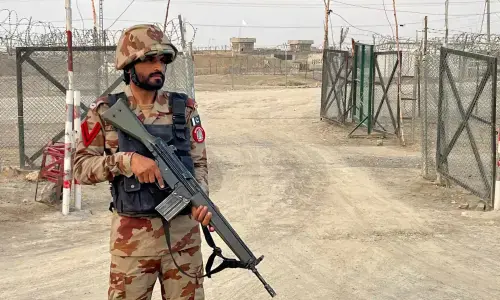
DIPLOMATIC, business and people-to-people contacts apart, a meeting between the senior military officials of two countries with an unfortunate history of hostilities has its own symbolism and value. The getting together of the directors general military operations of Pakistan and India at Wagah on Tuesday is significant, primarily because the meeting will improve understanding between men who, responsible for minding frontiers that have been the venue and source of sudden tensions gripping the two nations, are in the thick of it. The meetings can be used for making the point that skirmishes on the border are more a result of some, largely misunderstood, military manoeuvre and not reflective of national policies. The DGMOs have taken their time coming together. The push came following the meeting between prime ministers Nawaz Sharif and Manmohan Singh at the UN headquarters in New York in September. Clearly, the DGMOs’ meet was all the more necessary because the hotline connecting the two militaries was not having the desired effect.
Reportedly, Islamabad was keen on including diplomats in the meeting, a move which according to the Indian media enjoyed the support of the US. India, however, wanted to keep it limited to the two DGMOs and a few senior military officers who were there to aid them in their discussions. Maybe the scope of the meeting can be broadened in the future to create some space for diplomats but as current signs go, Pakistan does appear to be making an effort to expand the dialogue wherever it deems it possible and trying to accelerate the forward movement on peace. Whereas this is consistent with Prime Minister Sharif’s avowed wish for friendly ties with India, the past is all too replete with painful reminders of how such desires for peace can be overtaken by abrupt events.
The borders are as sensitive an area in the Pakistan-India region as any where the process of peace has to be carefully guarded; they are also indicative of some progress made. A series of skirmishes on the Line of Control in the summer did create quite a lot of tension but it also showed greater restraint on either side as compared to the past. The same approach has to be pursued in combating the theory which puts the lull on the Line of Control down to the onset of harsh winter conditions and which says that hostilities will return once the snow starts to melt. The positive exchange between the two DGMOs in Wagah on Tuesday, a milestone in the normalisation process, coincided with a meeting of the Pakistan Rangers and its Indian counterpart, the Border Security Force. These initiatives will need to be followed up with continued close contact over time. They must ensure that, after all these false starts, this time the thaw announces not temporary escape but permanent freedom from the past.