0
0

For a better South Asia
EXACTLY seven months ago, I argued in this space that it was not open to Pakistan to seek a fundamental review of Washington’s strategic decision to build India into a major global player at the expense of the India-Pakistan balance of power. It was, similarly, extremely unlikely that the United States would extend comparable nuclear-related technology and equipment to Pakistan.
This realistic, if somewhat pessimistic, assessment was based primarily on two inter-related factors: the evolving configuration of allied power as the US unfolds itself as a virtual overarching global empire and, secondly, a close study of the dialogue initiated by Strobe Talbot with New Delhi and Islamabad in the wake of the nuclear tests of 1998.
Ostensibly related to identical nuclear events in the two subcontinental states, the dialogue comprised diverging trajectories. It was rather myopic to see it in narrow nuclear terms; it was a subtle process of conceptual and political differentiation that pre-dated it, got deepened during it and gathered momentum after that particular round of negotiations.
The story of this historic shift in the US policy towards South Asia can be told in many variants. One can describe it in the language of historical inevitability, a development that could, perhaps, be delayed by factors intrinsic to the protagonists — the United States and India in this case — but certainly not denied. The deterministic factor in power alignments, rooted in compelling strategic and geo-economic considerations, has the advantage of absolving individual and collective actors — governments and nation states — of their share of responsibility for profit and loss inherent in these periodic transformations.
Alternatively, the narrative may focus on the quality of leadership, its vision, and equally significantly, the robustness of its institutions that analyse the drift of history and devise strategies to harness it to national advantage. Yet another perspective is the one that a triumphalist Indian establishment is highlighting at the moment — the comparative advantage of democracies vindicated time and again by history. “India’s democracy and the institutions that go with it,” writes the renowned Indian economist, Jagdish Bhagwati, “give her the edge in long-term stability and sustainable growth, relative to authoritarian China.”
In one form or another, this inter-relationship of development and democracy has been the matrix of President Bush’s present effort to restructure power alignments in Asia with India as a major element of it.
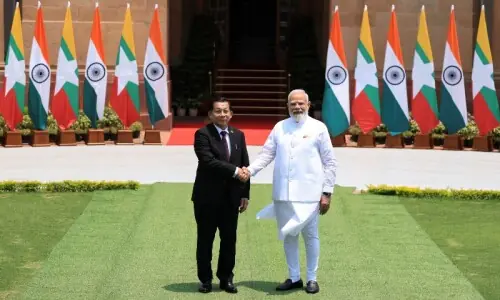
President Bush’s long-awaited visits to India, Pakistan, and shall we add, Kabul, doubtless herald the advent of a new hierarchy of power in the region. It is premature to arrive at a precise measure of what such occasions project as a tectonic shift. But the initial images have their value, particularly as they reveal the degree of satisfaction shown by the concerned parties. From India, in a torrent of early comments, comes a succinct judgment from the astute C. Raja Mohan. India, he says, “debuts as a new world power with new responsibilities.” Bush, in his evaluation, “has in one stroke torn up the long-standing premises about this region.” When a nation becomes a great power, he reflects, it is among those who maintain stability and order.
Many Indians and Americans may prefer to locate their planned shared global governance in the highly effusive references made to India’s democracy by President Bush in the Old Fort speech of March 3, 2006. He went beyond partnership to brotherhood, anchoring the idea of cooperative management of world affairs in a near-mystical relationship between the oldest and the largest democracies in the world.
Consider the challenging agenda. India would have felt flattered that this major address contained little direct or indirect reference to Kashmir and virtually invited India to play an enhanced role in creating a democratic Afghan state. But it is doubtful if the menacing reference to Iran would have been heard with equal equanimity by all segments of the Indian population. The new order for South Asia is problematic insofar as some of the pillars on which it is erected may not be as solid as President Bush wants the world to believe. In fact, it carries the risk of greater disorder.
Washington knows that India lacks many attributes of a global power and that an extravagant declaration about it by President Bush is not sufficient to attain it. So it has put together a comprehensive, multi-dimensional programme for India’s rapid development. It was, however, inherent in the nature of nuclear technology that it would stand out in bold relief. India has long since considered it as the passport to the status of a great power.
It would be churlish not to admire the sheer quality of India’s nuclear diplomacy spread over at least three successive Indian governments. Its latest achievement is the degree of success in retaining sovereign initiative in fulfilling the most important pre-condition of the nuclear deal struck between Prime Minister Manmohan Singh and President Bush on July 18, 2005, namely the separation of civil and military facilities fundamental to the design of a regime of inspection and monitoring.
The crux of the negotiations between the two countries was the safeguards for the fast breeder reactors insisted upon by the anti-proliferation lobby in the United States. It cited the example of no concessions made even to Japan, a natural exponent of the non-proliferation ethos. One heard from some of the best known nuclear experts that India would have to accept safeguards on the Prototype Fast Breeder reactor at Kalpakkam and the older Fast Breeder Test Reactor. But Manmohan Singh was willing to separate civilian and military facilities only on the basis of India having “the same responsibilities and practices and (acquiring) the same benefits and advantages as other leading countries with advanced nuclear technology.”
India, a non-signatory to the NPT, has achieved a singular success in persuading President Bush to drop the insistence on safeguards for the breeders. Estimates of the existing Indian stockpile of plutonium P239 vary but even the lowest can translate into a formidable arsenal.
India read the international situation with an impressive mix of accuracy, intelligence and imagination. Its objectives vis-à-vis the United States were anything but modest and it employed multiple approaches. By contrast, the Pakistani negotiators were burdened with a baggage of past policies that had become anachronistic and, therefore, costly. The occasional effort made by them to broaden the scope of the new post 9/11 relationship was constrained almost equally by Washington’s new dispensation for the region that now enmeshes South and Central Asia, and by the linear nature of a Pakistani regime particularly vulnerable to US pressure.
An exaggerated emphasis on the role of a so-called front line state in President Bush’s war against terror played an important role in shaping the Pakistan-US agenda. Fundamentally, President Bush arrived in South Asia with his mind concentrated on two aspects. First, Pakistan should continue to participate in the struggle against radical Islam with unflagging zeal. Secondly, Pakistan should receive assistance conducive to pervasive societal changes away from what was rather uncritically assumed to be its fundamentalist, Islamist legacy. Pakistan’s needs in the political, economic and defence-related domains, within that overall policy framework, had been assessed in minimal terms; it is considered necessary to curb undue Pakistani ambitions.
The visits were designed to be asymmetrical and, therefore, there is no surprise that the Indian part of it overshadowed the encounter with Pakistan. It does not, however, detract from Islamabad’s natural geo-strategic salience. A combination of circumstances, some of which like the cartoon protests are entirely fortuitous, made an unfavourable impact on it. An almost total elimination of a popular dimension from it added to its projection as a working review of their joint enterprises by two leaders beset with problems in pursuing them. While it provides a renewal of their entente within their preferred, if restrictive, parameters, it may end up by sharpening President Musharraf’s own dilemma.
He has been trying to nuance the war against terrorism by making valid distinctions between terrorism and extremism and by seeking a clearer focus on the causes of the present disorder. Bush prefers simplistic constructs and, more recently, has relied on ‘radical Islam’ as an almost permanent casus belli. President Musharraf has gained much from it for the perpetuation of his rule in uniform but from now, it may be a diminishing asset as he simply would not measure up to the ever-increasing demands on him to do more.
This is particularly so because in an example of classic disregard for Pakistan’s sensitivities, its armed forces are expected to make sacrifices even as Bush publicly transfers the responsibility of a democratic stabilization of Afghanistan to the brotherly democracy of India. The reiteration of this encouragement to India in the Old Fort speech was even stronger than in the Asia Society speech. The irony of the situation would not be lost on the people of Pakistan.
Pakistani efforts to balance the visits by hyping up the Kashmir issue have floundered as Bush began with tentative remarks in Washington and, faced with Indian pressure to get Pakistan to dismantle the alleged infrastructure of terror, withdrew into the safety of minimal public acknowledgment of any significant mediatory role.
A bilateral investment treaty and progress towards free trading arrangements, as between United States and Jordan or Morocco, represent welcome spikes in the curve of economic cooperation. Despite Prime Minister Shaukat Aziz’s stress on them, negotiations in this context have been marked by a lack of purpose, at least in the public domain. Noting that progress here “is receiving little pressure from Mr Musharraf” — one thing that would bind America to Pakistan — an editorial in The New York Times of March 3 regrets that “the Bush-Musharraf summit meeting is one between two leaders far more interested in guns than butter.”
Clearly, this economic space is where diplomatic efforts should be greatly intensified in the months ahead to challenge the newspaper’s description of the trip to Pakistan as “pointless”. The real importance of the visit to Pakistan lies in highlighting the great distance that Pakistan still has to travel in arriving at a durable and mutually profitable long-term relationship. Hard work, rather than premature celebrations, is the need of the hour.
The writer is a former foreign secretary. Email: tanvir.a.khan@gmail.com
Muslims & West on a collision course?
THE controversy rages on. There is no let-up in fury in either camp. The Muslim world is agitated at the deliberate and provocative insult to their Prophet (PBUH). The West regards it as unacceptable pressure on the freedom of the press. The lines have been clearly drawn and neither side is prepared to accommodate the opponent’s viewpoint. Each passing day is driving the protagonists to extremes and righteous anger.
The world of Islam is in flames with massive outpourings of protests and ugly scenes of violence targeted against European products and commercial ventures. Protesters want an apology from the Danish prime minister who has resisted this, maintaining that the government “cannot make apologies on behalf of a Danish newspaper. That is not how our democracy works. Independent media cannot be edited by the government”.
Meanwhile, the public outrage in the Muslim world from Indonesia to Nigeria is getting violent forcing governments, against their better judgment, to resort to recalling their ambassadors and boycotting the products of offending countries.
The European response, regrettably, continues to be obdurate, insensitive and provocative. Last month, the presidents of seven European countries condemned the violent protests, stating that “violence and threats are not acceptable under any circumstances”. The stalemate continues, deeply hurting interfaith understanding.
The controversy has now deteriorated to an exchange of threats and countermeasures. The boycott of Danish products by some Gulf retailers has invited the wrath of the European Commission, and Saudia Arabia has been warned that “Danish boycott would be a boycott of the European Union and it is a very serious matter”.
The determination of the Muslims to seek retribution for the gross insult to their Prophet and the West’s obduracy not to yield on the issue in the name of freedom of the press and “western values” has put the two on a collision course and irrevocably undermined the goodwill and friendly image of the West in the minds of the Muslims. The European line of reasoning could have carried some conviction had double standards not been in evidence. One only needs to remind the presidents of France, Austria and Germany, so upset at the Muslim outcry, that in their countries it is a crime to deny acts of genocide.
The Holocaust is taboo even for researchers to analyse or explain in a purely academic or historical context. Recently, British historian David Irving was sentenced to three years in prison by an Austrian court for denying the Holocaust.
How telling is the observation by Robert Fisk that “had the cartoon shown instead a chief rabbi with a bomb shaped hat, we would have had anti-Semitism screamed into our ears”.
Whatever the denouement of this unfortunate episode, it has not only created a huge chasm between the West and the Muslims; it has also generated a climate of pervasive hostility towards expatriates living in Europe as law-abiding citizens. The failure of those responsible to demonstrate any contrition or regret for the offence committed has hurt the interfaith harmony and exacerbated tensions.
The inadequacy and insensitivity of the West to appreciate Muslim sentiments on the issue has cast Muslims and the West in an adversarial relationship. It will need a long time to build bridges of understanding between Islam and the West, already under serious strain, with continuing aggressive US policies in the name of the “war on terror”, against the Muslims. The aggression in Iraq and Afghanistan and coercive diplomacy against Syria and Iran have further fuelled anti-US and anti-West feelings.
The images of humiliation and torture on the inmates of Guantanamo and Abu Ghraib prison and the current reports of barbarities and degradation of the prisoners by British forces have inflicted deep scars on the collective psyche of the Muslims and exacerbated their anger and outrage reflected in the suicide bombings against the US and western targets. The publication of the caricatures and the West’s refusal to take any punitive or corrective measures have confirmed their worst fears that the West and the US are implacable enemies of Islam.
European leadership and intellectuals, with their extremely myopic and biased outlook, hold the Muslim leadership’s failure to address the stagnation of their societies responsible for fuelling the tensions between Islam and the West. “Instead of hard analysis which thrives only in a free society, Muslims are generally brought up on propaganda, which is often state-sponsored. This propaganda focuses on Muslim humiliation at the hands of others instead of acknowledging the flaws of Muslim leaders and societies”, the argument goes.
This line of reasoning is partially valid. The conduct of most Muslim leaders and the internal crisis and contradictions of Muslim societies do contribute to anti-West sentiments. But the fundamental truth is that the same leaders are being hailed and supported by the West itself. The forces of democracy and factors of stability are being undermined to keep the Muslims depressed and dispossessed.
All kinds of interpretations are being made to explain and justify the current onslaughts against the Muslims. Appalling atrocities and barbaric attacks against innocent civilians in Iraq are being justified as acts against fanatics and Islamic terrorists. Ignoring the total failure of US policies in Iraq and Afghanistan, Bush brazenly claims that Iraq and Afghanistan are people are on the path to democracy and freedom and that “these two nations will be a model for the broader Middle East”. These claims are laughable in the face of America’s and the West’s refusal to accept the Palestinians’ verdict in favour of Hamas in the recent elections there.
The US policy has been formulated and justified in the context of 9/11. The truth is, however, that 9/11 is used as a reference point to violate international law, ignore the UN and to pursue strategic advantages.
How then can one argue against those who hold the view that Muslim countries are being identified, isolated and prosecuted as part of a concerted campaign by the US and the West to weaken and neutralize them?
The images of Guantanamo Bay, Abu Ghraib indiscriminate bombings in Fallujah, and support to Israeli policies of target killings, closures, curfews, demolition of houses in occupied Palestine and now the offensive cartoons and the angry reaction to these will only invite more terror and bloodshed, and put the Islamic world on a collision course with the West rendering the theory of the clash of civilizations a self-fulfilling prophecy.
The writer is a former ambassador.
Relocating the US consulate
‘HAVING a good time, wish you were here.’ This was the kind of one-line message one received from a friend back in the 1960s whilst he was enjoying the winter sunshine in Blackpool, or stretching his legs on the pier at Bournemouth; or reading about Stephen Spender’s ‘gentle ocean, (which) like an unfingered harp, spread her white lace on the shore.’
It might sound a little strange, after all that’s happened in Karachi during the last 30 years, but there was a time when one could, and probably did, scribble this sort of message on a postcard and dispatch it to a friend living abroad. The ’60s were Karachi’s golden decade. There was no democracy. But there was a lot of law and order, and one didn’t have to look over one’s shoulder while wolfing down nihari in Burns Road at four o’clock in the morning.
These days, one would be loathe to send this kind of memo to anybody living abroad, unless one harboured a sinister desire to drastically shorten his temporal existence — what with bomb blasts, riots, demonstrations, strikes, demands to recall ambassadors, exhortations to sever diplomatic relations with every country that printed those disgraceful sacrilegious caricatures, more strikes and more demonstrations. On this occasion there has been no let-up in the fury that has erupted, and one never knows when the next riot will take place. The damage in Lahore alone was estimated at over a billion rupees.
Every time the mob goes on the rampage, setting fire to foreign banks and fast food establishments, smashing cars, burning buses, and killing a few people in uniform who try to stop them, one is reminded of those opening lines of Yeats’ powerful poem The Second Coming which describes far better than any ode this writer knows of the state of affairs in Pakistan today.
‘Turning, and turning in the widening gyre/The falcon cannot hear the falconer./Things fall apart, the centre cannot hold;/Mere anarchy is loosed upon the world./The blood-dimmed tide is loosed, and everywhere/The ceremony of innocence is drowned;/The best lack all conviction, while the worst/Are full of passionate intensity.’
It is by now clear to the thinking man that the recent turmoil was caused by a number of reasons: chronic unemployment, the rising cost of living, the inability of the government to curb some of the heinous crimes that are taking place and needless extravagance by officials who have a penchant for wasting the taxpayer’s money. An uprising had been on the cards for some time. All that was needed was an event or an incident to blow the lid off the bottle and trigger off a mass revolt. This was provided by a clutch of editors in Denmark and a number of other European countries. Predictably, whenever there is gross disenchantment in the Muslim world, US embassies and consulates are targeted, even though on this occasion the Americans wouldn’t touch the cartoons with a barge pole and actually condemned their publication. The assault on the US consulate general in Karachi nevertheless took place, and it was certainly not the first of its kind.
The white building on Abdullah Haroon Road which hoists the American flag, shaped like a small ocean liner with its portholes facing Frere Hall, has an interesting history. An entry in my scrapbook points to a piece by the late Australian journalist Richard Hughes. In an article in The Far Eastern Economic Review he wrote that a fakir’s historic curse would have been blamed for the November 1979 burning of the US embassy in Pakistan by rampaging students, had the state department not correctly shifted it from Karachi to Islamabad when the latter become the capital of Pakistan.
The current consulate general is apparently built on cursed and haunted land. It has survived in popular belief because for the first and only time in history did the state department bow to superstition and adjust architectural design “to placate the supernatural”. According to Hughes, over a hundred years ago, a rich Parsi gentleman by the name of Sohrabji Rustomji built a beautiful residence on this very spot, which later came to be referred to as Sudden Death Lodge, because whoever resided in the place or had anything to do with its construction was swiftly dispatched to the kingdom beyond the clouds . In the centre of the plot was reputed to be the tomb of a pir. The story goes that a fakir appealed to Rustomji not to trespass upon the grave. The plea was apparently rejected and a curse was solemnly placed upon the place.
The curse became effective at once. Four workmen died in the course of duty, members of the Rustomji family perished mysteriously and an English family by the name of Reid that subsequently took up residence pegged down from unnatural causes. The building was razed in 1925, and this large tract of land, located on the road named after Queen Victoria, remained vacant for 30 years. Readers with a macabre sense of history who are interested in other fatalities that took place in the building should read Dew and Mildew, by the distinguished English education official, Percival Christopher Wren, who faithfully and gruesomely documented the continuing fatality.
A number of US consuls general in Karachi, Faulk, Archard, Kennedy and Bauman, had at various times expressed dissatisfaction with the building. They cited reasons for wanting to shift to another location, like faulty air conditioning and inadequate security. In private conversations, however, what came across was that these diplomats were also concerned with the fact that their office was located at a strategic and sensitive commercial location, and that every time Abdullah Haroon Road and Fatimah Jinnah Road were closed to vehicular traffic, after there was a whiff of insurrection in the air, it caused the travelling public no end of misery.
Two plots were subsequently made available — one next to the Karachi Grammar School in Boat Basin and the other in Phase 8 in Defence Housing Authority. The former caused a storm of protest from parents of school-going children and the latter was rejected because it was too close to the sea and was vulnerable to amphibian attacks. Finally, much to the relief of the officials, the waiting is over.
A news item appeared in a section of the press on September 26, 2005, which reported that the Karachi Port Trust had approved the allotment of a piece of land measuring 10 acres, situated on Moulvi Tamizuddin Khan Road, for the construction of the new American consulate at Karachi. The report added that the present location of the US consulate at Abdullah Haroon Road had been under threat since 1995, particularly after 9/11, though it did not specify how the new location would in any way diminish or lessen the threats to the building or to the officials who worked within.
The public learned that the new US consulate would be constructed by demolishing the present building of the Central Cotton Committee, which also houses the Wool Testing Laboratory. There was a charming bit about the building being “one of the architectural landmarks of Karachi depicting the blend of cultural values of both the United States and Pakistan” and about the move marking “an important step in the revitalization of the M.T. Khan Road, an important link of the city with the port area, which had fallen into disrepair in the past two decades.”
One hopes that the people who run the KPT know what they are talking about, because anybody who has recently travelled on the road originally named after the queen-empress of India would acknowledge the fact that currently M.T. Road, when judged by its importance, is probably the worst thoroughfare in Karachi. One wishes that the next time the prime minister or the president decides to pay a visit to this city, their 10-car motorcade is taken on a sightseeing tour on the stretch between PIDC house and the Bahria Centre.
The report concluded by stating that the Pakistan government was reportedly of the view that the addition of the new building at M.T. Khan Road would help in improving the image of Karachi and the construction would be used as symbol to attract more American investment in the country. Why does one get the feeling that we’ve heard that one before?
Churchill’s iron oratory
SIXTY years ago an ageing British politician made a speech at Fulton, Missouri, and conjured up a metaphor that helped define an entire era. Winston Churchill had recently been dismissed by the electorate despite his wartime popularity.
George Orwell had already come up with the phrase “cold war” to describe the looming confrontation between the West and the Soviet Union, but it took the former prime minister’s fecund literary imagination to think of an “iron curtain” which had descended, in his words “from Stettin in the Baltic to Trieste in the Adriatic”.
The Fulton speech on March 6 1946 was characteristically both gloomy and uplifting. It was a bit rich to complain that the great capitals of central and eastern Europe, from Warsaw to Sofia, were now in the Soviet sphere, since Churchill had agreed to just that with Stalin in 1944. Still, the terms of the debate were hardening and the Soviet Union was coming to be seen as an ideological, totalitarian enemy bent on spreading instability and communism into western Europe.
Churchill, as Stalin noticed, was also trying to boost the British-American relationship, with consequences that linger today. The US, of course, was equally bent on spreading and defending its values. European history since 1989 provides a definitive judgment on the rights and wrongs of that confrontation. Churchill’s “iron curtain” was an inspired image for a dark time.
The world is better off now that the reality it represented has gone.
— The Guardian