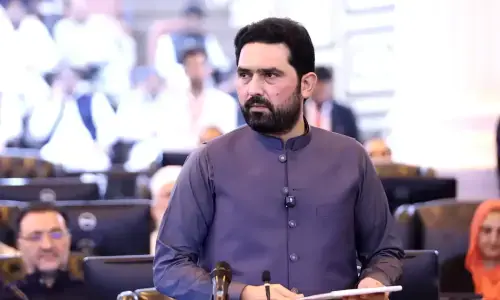
PESHAWAR, Nov 20: Speakers at a consultation here on Wednesday urged the government and people from all walks of life to consider the right to adequate food and nutrition as a basic human right, regretting currently, it’s not a priority area, which has resulted in nutrition challenges in the country, especially Khyber Pakhtunkhwa.
The event was organised by the Development Partners for Nutrition (DPN) and Save the Children Pakistan to promote nutrition as a basic human right by increasing the understanding and knowledge of the civil society organisations on nutrition for better advocacy.
Nutrition specialist at Unicef Aien Khan said according to National Nutrition Survey of 2011, the nutrition challenge facing the province was substantial.
“The province has a dangerously high rate of nutritional stunting among children under 5 is 47.8 per cent as compared to 43.7 per cent of the national average. The prevalence of wasting is 17.3 per cent compared to 15.1 per cent of the national average,” he said.
The nutrition specialist said according to the World Health Organisation standards, a national average of 15 per cent or above was labeled as an emergency.
He said unfortunately, the figures in question had not changed significantly in the past decade and therefore, they should be given special attention at all levels.
Adnan Sajid, provincial manager advocacy and campaigns at Save the Children, Khyber Pakhtunkhwa, said nutrition had never been considered a priority area and had always been taken as part of health but it had been realised that health interventions alone couldn’t deal with the issue of malnutrition.
Visiting professor at the Department of Human Nutrition, Agricultural University, Peshawar Dr Parvez Iqbal Paracha said nearly half of Pakistan’s children and mothers suffer from under-nutrition.
He said the situation was worse than that in much of sub-Saharan Africa.
“Chronic malnutrition levels in Pakistan have not changed in last 40 years,” he said.
Programme Officer at World Food Programme, Khyber Pakhtunkhwa Amjad Bacha shared the overall situation of malnutrition in the province, especially that of stunting and wasting, and aid the rate of change for both stunting and wasting had been very slow in Pakistan.
“More than 350,000 children die in Pakistan every year before their fifth birthday and 35 per cent of these deaths are due to malnutrition,” said Dr Sohrab Khan nutrition officer WHO, Khyber Pakhtunkhwa.
Dr Umar Khan, provincial manager at Khyber Pakhtunkhwa-Fata Micronutrient Initiative (MI), said Iodine deficiency was a serious public health problem and the single most common cause of mental handicap worldwide.
He said it was totally preventable but special attention of policymakers and legislators was much needed.
Dr Irshad Danish, a consultant for Nutrition Advocacy for Save the Children and DPN, emphasised the importance of the role of human rights organisations in addressing the issue of malnutrition in Pakistan.
The presentations were followed by discussion on the role of civil society organisations in advocating effectively for the right to adequate food and nutrition and in the adoption and implementation of important laws like the Protection of Breastfeeding and Young Child at the provincial level.