IT may be an artificial benchmark — 100 days of a government — but it nevertheless has symbolic value and can go some way in identifying early governance trends. On that count, Nawaz Sharif has little to be satisfied about in the first 100 days of his third stint as prime minister. What has become obvious is that Mr Sharif and the PML-N have come to power with little preparation — as evident from the fact that ministerial posts in key departments, such as foreign affairs and law, have yet to be filled. More surprisingly, there is a lack of awareness. For a party that has ruled Punjab since 2008 and a leader who has been prime minister twice before, it borders on the inexplicable that the federal government, in its leadership’s own words, has been taken by surprise at the extent of the problems confronting the country and the institutional decay that has left the state unable to launch an immediate response.
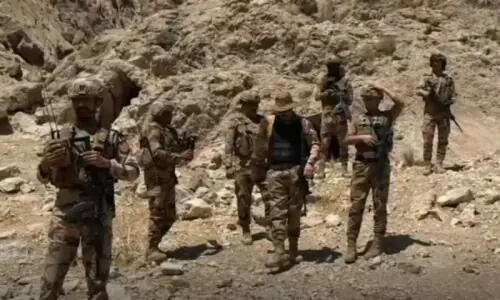
Take just the three issues that this government has evinced serious interest in over the past three months: the energy crisis, the militancy threat and law and order in Karachi. To the government’s credit, on each of those issues there has been a sober assessment put forward and no extravagant claims or promises made. The contrast with the last government has been a welcome one in this regard. What has been less encouraging though are the government’s plans to address those issues: saying what needs to be done is one thing; demonstrating how the responses will be effective and if there is the political will to see the plans through is quite another. The elusive element is political will: for every plan, be it on energy or internal security, there will be resistance, some of it deliberate, some simply because institutions have decayed and no longer have the capacity to deliver. How, for example, will the government determine red lines in negotiations with the TTP and how committed will it be to delivering a forceful response if the TTP rejects the government’s peace overtures? The answer is dismally unclear.
Uncertainty there may be on many fronts, but some perspective is also necessary. The PML-N government exists in a framework of unprecedented political stability: where the likely lifespan of previous governments was always seen as significantly shorter than their constitutional terms, the present government can be reasonably comfortable it will complete a full term. That calls for some recalibration of expectations. Give the government time and space to work and perhaps results will improve going forward.